
AT HOUGHTON Festival, Ryan Gander planted three enormous questions into the landscape – an invitation to stop, wonder and quite possibly try to answer the absurd. The British artist, who is renowned for over two decades of work spanning different forms, from sculpture and performance to writing and typefaces, brought an element of humour to the music-fuelled weekend.
In the midst of dancing, exploring and socialising, his huge black PVC balloon sculptures prodded spectators with the unanswerable: Do you smile in your sleep?, How far is a head start?, Is everything necessary? Known for making work that lingers in the liminal space of the in-between, Gander has never been interested in singular understandings of what he does; rather, he revels in the magnitude of the many.
What better place to put art than in a space like Houghton’s, where your imagination has been invited to be set free?
You’re on record as resisting the label ‘conceptual artist’, so what would you call yourself instead?
I guess people know that know me, they know I’m an artist. They say I’m an artist, and people often say that I’m associated with the strand of art that’s called contemporary conceptual art. But I don’t. When I get in a taxi and the taxi driver says, “What do you do?”, I never say I’m an artist because it leads to loads of really annoying questions. So I usually say I’m a teacher or I’m in education related to the art world, because I think that’s true. Because I believe, by definition, all art should be about lifelong learning and experimentation.
There’s a weird culture, isn’t there, in Britain? You learn when you go to school, and the further you get away from the culture of education, the more you’re meant to know stuff and have all the answers, which is bullshit. I think that’s where all prejudice comes from. People learn answers, they go to university, ask questions, learn the answers, and remember them. Well, the answers are completely out of date within a month because the world moves so fast.
I went to one of my kids’ art classes once, and I saw the teacher saying, “Stop looking out the window. Stop daydreaming.” I was like, “Fuck! It’s art class. You’re meant to be daydreaming. That’s the point of being there.” And then the other thing is, they’re like, “Focus. Stop being distracted.” But we have computers and machines to focus. The greatest asset is us being distracted and making mistakes and being wrong, or, like, the serendipity and weirdness of being human. Machines can’t make mistakes.
So, I just came up with this idea that school, art school, but also school for kids, should really be a place where you just ask questions, or ask questions that don’t really have answers.
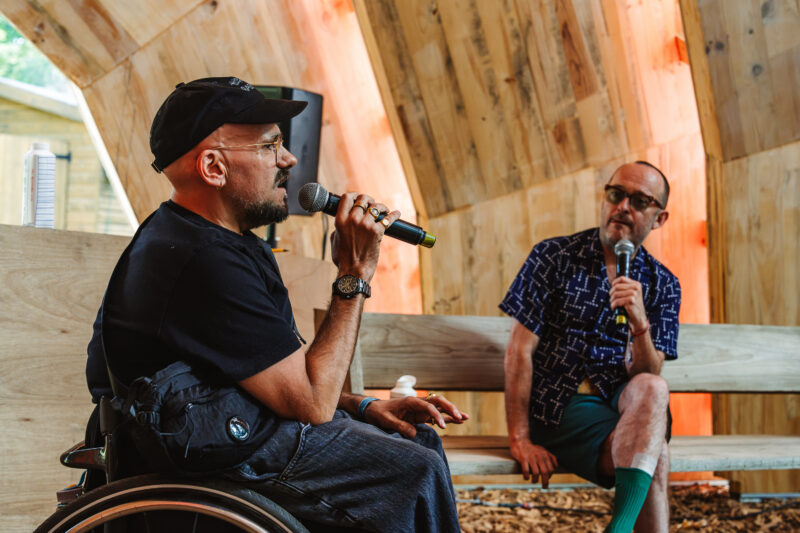
Ryan Gander at Houghton 2026. Photograph: Benedict Priddy
So much of your work operates through absence and speculation, sort of forcing the viewer to suggest their own a story rather than reveal your one. What interests you about the space between what is known and what is imagined? Is it the fact that there is a freedom to explore?
It’s a good point because, essentially, the difference between a great artwork and a terrible artwork is that a great artwork has a million different interpretations if a million people see it. And a shit artwork just has one. Everyone says, “Oh, I know what that’s about.” Well, that’s not art. That’s just communication. I could just tell you; I wouldn’t need to make an artwork to describe something to you, would I?
This is why I’m not a massive fan of painting. I mean, I like paint, but I don’t think it’s a really good medium. Historically, it has been a good medium, but just because it’s very difficult to get multiple interpretations out of a painting, because it’s pictorial. Even abstraction has a singular history; it doesn’t have multiple histories. It just has the history that we know.
So, for me, there’s the seesaw between ambiguity and accessibility. So, you want the spectator to be drawn into the work and to feel a little bit addicted to it and want to, like, engage with it. So, you need some sort of candy, like eye candy or brain candy or body candy, some kind of kawaii cuteness or some humour or something that makes them engage without feeling pretentious or feeling like an imposter, or feeling elitist, like they’re in an elitist world.
But when they get engaged, you don’t want to just tell them something. You don’t want to hand them something on a silver plate. There has to be enough ambiguity and enough absence, enough of a space in the work, enough missing from the work to enable them to bring their own interpretation. So, there are multiple interpretations for the work.
If I make a work and there are loads of different interpretations when I speak to people about it, and they all come up with different ideas and different interpretations, I think it’s a really good work. If everyone says the same thing, then it’s just didactic. There is no ambiguity.
So, I think the difference between asking questions and answers, as you just posed in your question, is that questions are singular and answers are multiple. So, you can ask a question, but the answers should be many. And the more absurd the question, and if it’s unanswerable, like, “Do you smile in your sleep?” or “How far is the head start?” and “Is everything necessary?”: there are millions of answers to those questions, depending on where you’re from, what demographic, race, class, culture, religion, and upbringing. You know, all these things make open-source artworks, in a way. It makes art that is interpretable rather than answerable.
Do you smile in your sleep?, How far is a head start?, Is everything necessary? Did these three arrive together, or did you have to whittle these down from an array of questions to show at Houghton?
Its from a list of 2000 questions. I didn’t think of them all, obviously. A guy that works at the studio here – he’s like the senior producer – makes sculptures with me. He’s got a really good mind. He came up with loads. My kids, came up with some, and other people’s kids, and just other people.
The first one was from my friend Eduardo in Mexico. We were out somewhere – I can’t remember. I was doing a show in Monterrey, and we were out together, driving around and laughing. He said he’d had a bad night’s sleep, and I was like, “What were you thinking about? Like, what was on your mind? Why couldn’t you get to sleep?” He was like, “I don’t know. I was just thinking loads of abstract shit. Like, do ghosts have teeth?”
And that was such a good question: “Do ghosts have teeth?” Because it’s so implausible. Because ghosts don’t even exist. They’re made of nothing. Teeth are dead, solid, but also creepy. What would they eat? Why would they need teeth? Do they bite people? So there’s all this—it goes off in loads of tangents. And I was like, it’d be great to just make a list of questions that were that abstract and had that many interpretations. Like, “Do ghosts have teeth?”
So he kind of started it when he said, “Do ghosts have teeth?” I wrote it on my phone, and then he started thinking of them. I asked other people to think of them.
As each title is a question nobody can actually answer, is the point that people stop and try anyway, or is the point that they don’t? Or do you want the question to stay with them throughout the festival?
I don’t usually decide what people do with them. I think if they’re intriguing enough, you know, that kind of approachability thing that I just talked about, like the accessibility thing. But if there’s enough of a hook, enough that’s related to the weirdness and serendipity of life, that you stop and go, “What’s this?” then, as long as you’ve got them, you’ve got the audience, and they can do what they want with it.
It’s kind of funny, isn’t it? And the fact that they’re like balls is funny, because questions are intangible; they’re kind of very ephemeral and nothing. You know, they’re just words. You can’t hold them. And then trying to make them physical, like these big balls that are, like, filling your head, or that, you know, are questions bigger than you, on the human scale, is quite a weird idea. Like, this big question, and then the big question is obviously a really futile, stupid, slapstick question. It’s the contradiction in that that’s really interesting.
Your sculptures for Houghton exist in a very different context from a gallery or museum: they are encountered while people are moving, dancing, socialising and listening to music. Does the festival environment change the way you approach a commission?
It’s a different context, but I didn’t think about it. What I like about the balls is that they go in a gallery when they’re in a space like a traditional art space, like a gallery or museum. I usually pop them in an absurd place, like in the doorway, so you get to the gallery or the museum, and the doorway’s blocked, or there’s a very narrow passage. So you actually have the questions in your way, so you have to, like, shimmy past this ridiculousness, like the elephant in the room. Yeah. So you feel like the question is in the way of the show.
But the great thing about them is they work as artworks in, you know, museums and that, but they’re also great public art and temporary public art. They’re also weirdly really good for the environment because there’s minimal shipping, minimal storage. They’re made of air, basically. So when you transport them, they’re tiny and really lightweight. In comparison, you know, they do massive bronze sculptures for public art and things, which is just a huge resource, you know, on the planet, not on us.
So I think they’re really good because they’re like pop-up artworks. I mean, it feels like we’re doing so much at the moment. We’ve done, like, some in the snow in the Swiss Alps. We’re gonna do one in Venice and the canal. We’ve got one in a palazzo in Venice. So they go to all these different places. It feels like I’m a giant chucking little ping-pong balls all over the world. Do you know what I mean? Yeah. And they’re like bubbles or something. They just appear and disappear with these questions.
That’s funny, actually, to say bubbles. I’ve not said that or thought that before. And I think they are a bit like bubbles because they just seem to appear and disappear quite quickly in places. You know, they’re very temporary. I like them.
They make zero money. No one ever buys them because people want solid art that they can sell in 100 years. Nobody wants a fucking inflatable. But, you know, good art isn’t necessarily art that makes cash. Good art is the art that stays with you when you’re on your way home on the bus. You can’t stop thinking about it, so it does something, all right, I think.
Looking back across your career from early conceptual works to large-scale public sculptures, what ideas or questions have remained constant, and what have you fundamentally changed your mind about?
Fundamentally, I have changed my mind about form. So, my dad worked in Ellesmere Port at Vauxhall as an engineer, and I remember when I was little, he said-well, he said that cliché, you know: “Whatever job you do, do one you enjoy, then you’ll never feel like you’re working a day in your life.” But the other thing he said that really seemed to make sense was, we were watching a documentary about a well-known artist, who I won’t mention, when I was a kid, when I was like 15 or something, and he said, “Why does she always make the same thing, but just like different size and different colour?” And he said, “That’s like working at Vauxhall, you know, on a production line. Essentially, you do the same thing every day. It’s incredibly repetitive.” And he said, “That’s the thing I dislike about my job the most.” He said, “If you do end up being an artist, make sure you do a different thing every day.”
Joseph Beuys always said, “Art is the science of freedom,” which was kind of it, really. So, for me, the thing that changes is everything from one work to the next. You can do anything in art. That’s the thing. So it’s kind of bizarre that we use the word “practice”, which means repetition. The idea of an artist’s practice is to do the same thing again and again and again and again. But the point of art for me is to explore and to roam and to change and to make mistakes and not be perfect. Just try shit out. So that’s the motivation of the thing that changes.
Is that the thing that stays the same? It’s probably the motivation. The motivation is, you know, when you see an artwork and you think “Do I like it?” The way you value it, the yardstick by which you measure if it’s successful or not. So you might ask questions about its use, cost, function, worth, authorship, ownership. You might say, “Do I like it? Would I have it in my home? Is it an original contribution to human history?”
So there’s all these ways that we weigh up whether art is good or not. But I think, for me, the best way to measure how good art is is to ask, “What’s the artist’s motivation?” So if you look at the intent, or the intention, of an artist, intent’s really important. You will find that most artists want to be successful. Artists, they want notoriety. A lot of them want money, or a lot of them want lifestyle. Then you find people who are, like, “I do it for therapeutic reasons.” They’re like, “I can’t do anything else,” or “I’d be in prison if I wasn’t an artist.” Or then these are the people that are obsessive, where it’s just like a kind of a neurodiverse trait, but they can’t help but maybe be creative.
I’m on the kind of strain that’s quite egomaniac, but also, like, a kind of ethical egomania, which is—there’s a thing that’s talked about, “the artist’s artist”, which is like artists that other artists really fucking love.
So I go to the pub and I sit next to an artist. You’re having a drink. Say she tells me what she’s doing in the studio, and I’m like, “Shit, that’s amazing. I want to go back to the studio now because I need to do it. I need to make better stuff than her because what she’s doing sounds…” I want to be that artist. I want to be the artist that other artists are like, “That’s good. I wish I’d done that.” So that’s the motivation. It never really sways, but the form is constantly in flux, moving.
by Imogen Clark