
IN Emilia Momen’s new paintings, no one performs. Bodies stretch, recline, wander; they pause by the water or drift in its shallows, absorbed not in how they are seen, but in how they feel.
Bathers, Momen’s first solo exhibition at Ronchini’s new Conduit Street space, quietly but radically reframes one of art history’s most persistent motifs. Once a site of projection and idealisation, the bather returns as a subject immersed in physical experience, not an object for contemplation.
Set across recognisably British landscapes from Richmond’s Thames-side meadows to Bexhill’s rocky shoreline, the paintings chart a choreography of leisure that feels both ordinary and strangely rare.
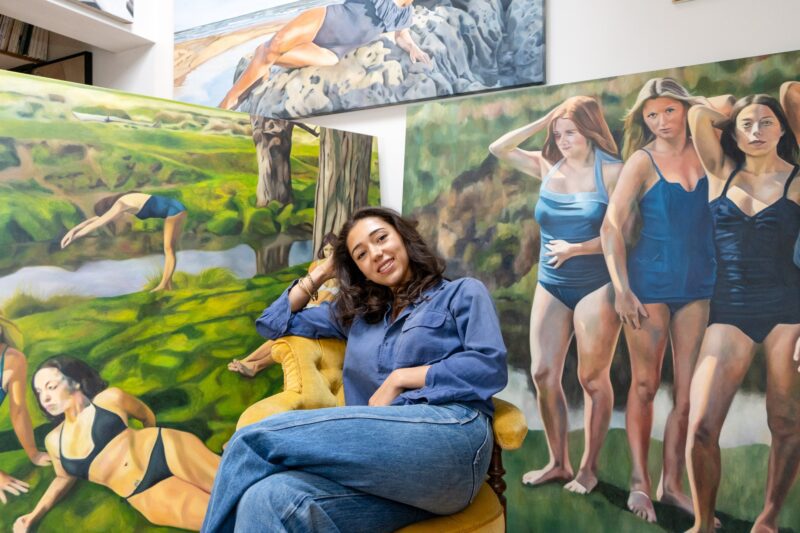
Emilia Momen. Photograph: Marlowe Turner
For those less versed in the history of bathers in Western art, they have featured as far back as Titian’s mythic nudes to Cézanne and Seurat, and shapeshifted across pastoral idylls to scenes of modern leisure. Momen, however, does not reject this lineage so much as step directly into it, wildly alert to its beauty, and newly conscious of its constraints.
“Since I’ve been painting my series of bathers, my whole perspective of being a woman has changed,” she says. “Perhaps I was quite naïve before. I realised how male artists constantly portrayed women in a submissive and sexualised way.”It was not something she initially saw in the images themselves. “Looking at those paintings, I wouldn’t have seen them like that. But after reading about it, I now can’t unsee it.” That shift in awareness seeped directly into her process.
Momen works from photographs taken during informal shoots with friends, encouraging movement rather than fixed poses. Early on, she noticed how deeply ingrained habits of self-presentation were. “I would observe the way the models were posing at the beginning,” she says. “Then I’d say, ‘Can you just act as if men aren’t going to see this? Try and act as if you’re posing for the female gaze.’”
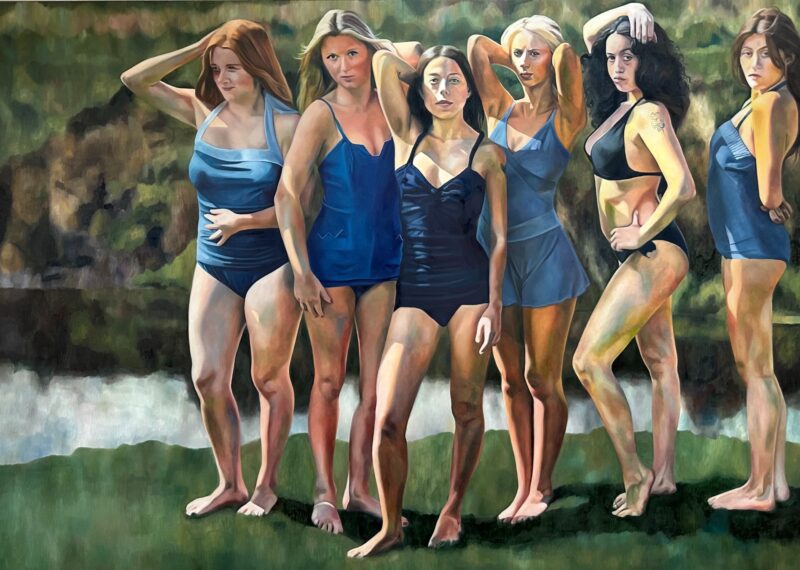
Ladies by the Lake | 140cm x 210cm | Oil on linen
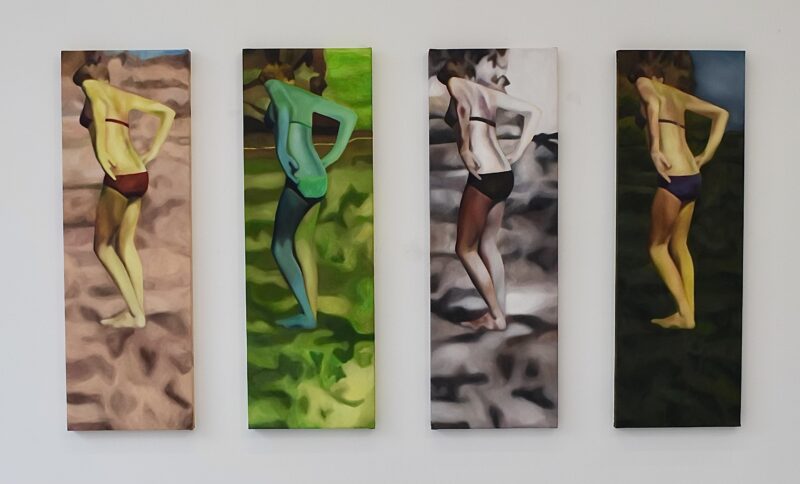
The Wanderers | 120cm x 40cm each | Oil on linen
The effect was immediate. “Everyone just relaxed. They stopped arching their backs. It was so strange, because they’ve obviously been indoctrinated into thinking of beauty as perceived by the male gaze.” What emerged instead was something quieter and more grounded. “I think they look more naturally beautiful when they’re not aware that anyone’s looking at them at all.”
That unselfconsciousness defines the exhibition. Figures feel absorbed rather than displayed, engaged in the sensation of the moment rather than its future presentation. If there is an innocence here, it is not naïve but hard-won: a shedding of habits learned over a lifetime of being seen, liked and commented on.
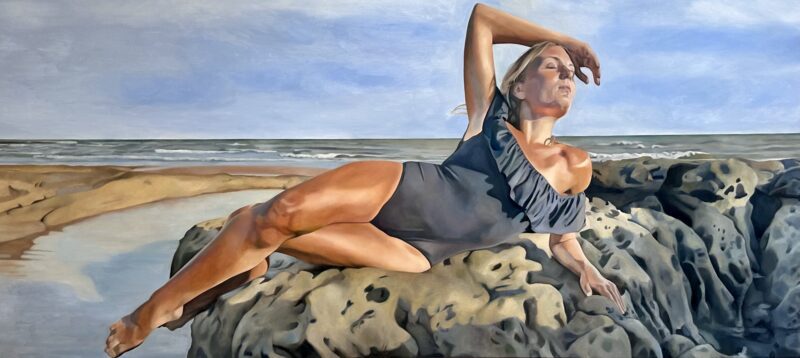
Bexhill Bather | 180cm x 80cm | Oil on linen
This is maybe why throughout Bathers, Venus seems to be hinted at and referenced. In Bexhill Bather, the reclining pose recalls Alexandre Cabanel’s Birth of Venus (1863); elsewhere, Daisy echoes the contrapposto stance of the Venus pudica. Yet Momen’s figures resist idealisation. “The two paintings that stayed with me the most were Philip John Thornhill’s Andromeda and Cabanel’s Birth of Venus,” she says. “They’re such beautiful paintings because women are beautiful but it’s a shame that history sees them as erotic. I personally don’t.”
“I always assume that everyone’s going to look at the paintings the way I do,” Momen reflects. “In a very innocent way. Whether they have clothes on or clothes off, I would never look at any of them in a sexual way.”
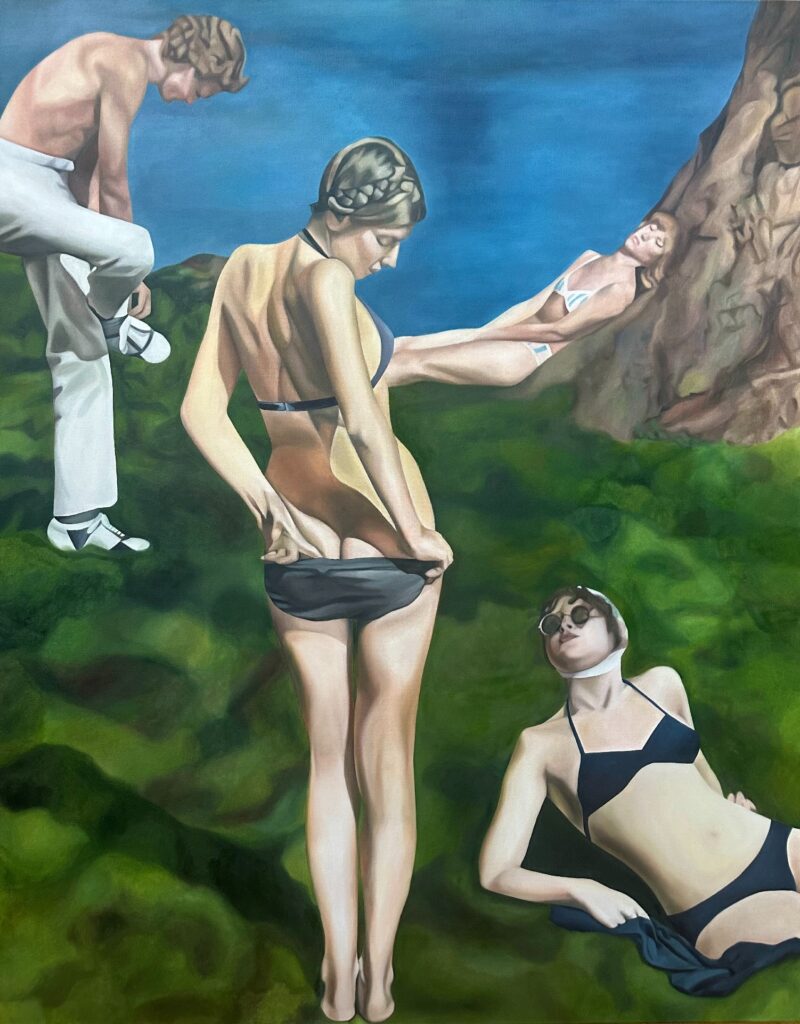
Bathers II | 120cm x 110cm | Oil on linen
That assumption was tested when Momen turned the gaze on herself. A recent nude self-portrait forced her to confront the very pressures she sought to dismantle. “I didn’t think it would affect me at all,” she says honestly. “I’ve painted my friends almost naked and didn’t even think twice about it.” But when she reached her own breasts, she stopped. “I thought, ‘I can’t. I actually don’t think I can do this.’”
She found herself analysing details – echoing society’s prevalent desire to edit, to correct. “I now realise why people say, ‘Can you make my tummy look smaller?’ It used to irritate me.” She didn’t change anything. She painted what was there.
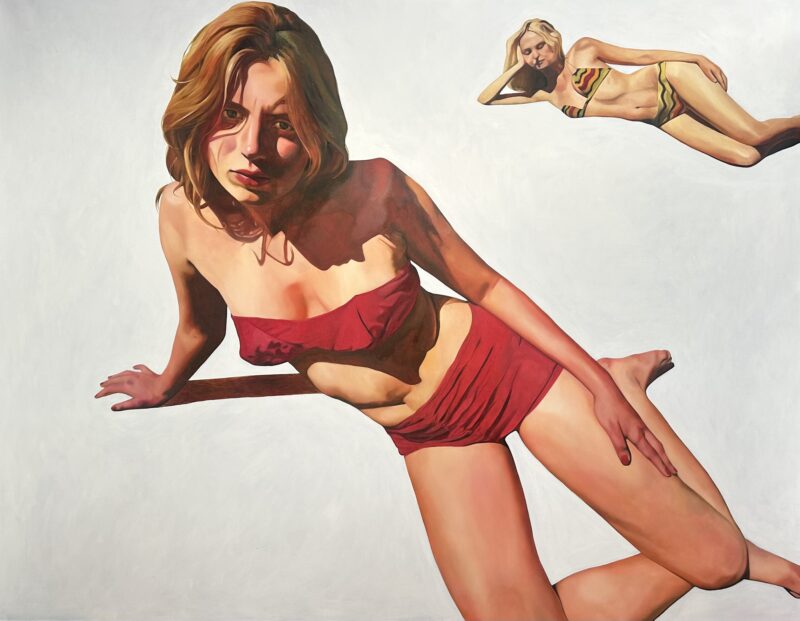
Zof & Mimi | 180 cm x 140cm | Oil on linen
The exhibition was sparked when Momem discovered a photograph by the late fashion photographer Jim Lee, whose work drew from Seurat’s Bathers at Asnières. Painting to photograph to painting again, the lineage loops back on itself. “When I saw the photo I knew I had to turn it into a painting,” Momen replied. “I couldn’t rest until I had done it.”
With Bathers opening this evening, the young painter admits to feeling unexpectedly protective of the figures she is showcasing. Still, her hope for the exhibition extends beyond ownership or interpretation. “I would love the paintings to fill someone with that overwhelming need to create for themselves,” she says. “To feel the emotion of the person in the painting or the scene that they’re in.”
In Momen’s hands, the bather is no longer a body caught between water and land, art and flesh. She is simply there: present, unguarded, immersed. And perhaps that is what lingers most, not the image of the body, but the sensation of being freely at home within it.
by Imogen Clark
Emilia Momen’s Bathers will run from 22 January to 26 February 2026 at Ronchini Gallery
First Floor, 21 Conduit St, London W1S 2XP