
FREYA Tewelde’s paintings are mesmerising swirls of colour, hypnotic portals to other worlds. Rather than tumbling into a new dimension, Tewelde invites the viewer to enter her paintings gradually, absorbing each stroke as they morph and blend between recognisable shapes and forms, movement and stillness.
Opening as part of London Gallery Weekend, Geometry of Elsewhere is Freya Tewelde’s first solo exhibition with Gallery 1957, which presents leading artists working across West Africa and the diaspora. Its London hub is a vibrant outpost and platform for African and diasporic artists in the UK, with spaces also in Accra, Ghana. Tewelde was born in Asmara, Eritrea, and raised in Saudi Arabia, drawing on her diasporic experience and ancestral heritage to explore the notion of ‘in-betweenness’.
The title of the exhibition emerged as the paintings did, Tewelde tells me, “although the works are abstract, they contain their own internal structures and spatial relationships. They don’t necessarily conform to conventional boundaries; instead, they create their own edges, thresholds, and forms within the space of the canvas. I became interested in the idea that each painting was generating its own geometry from within.”
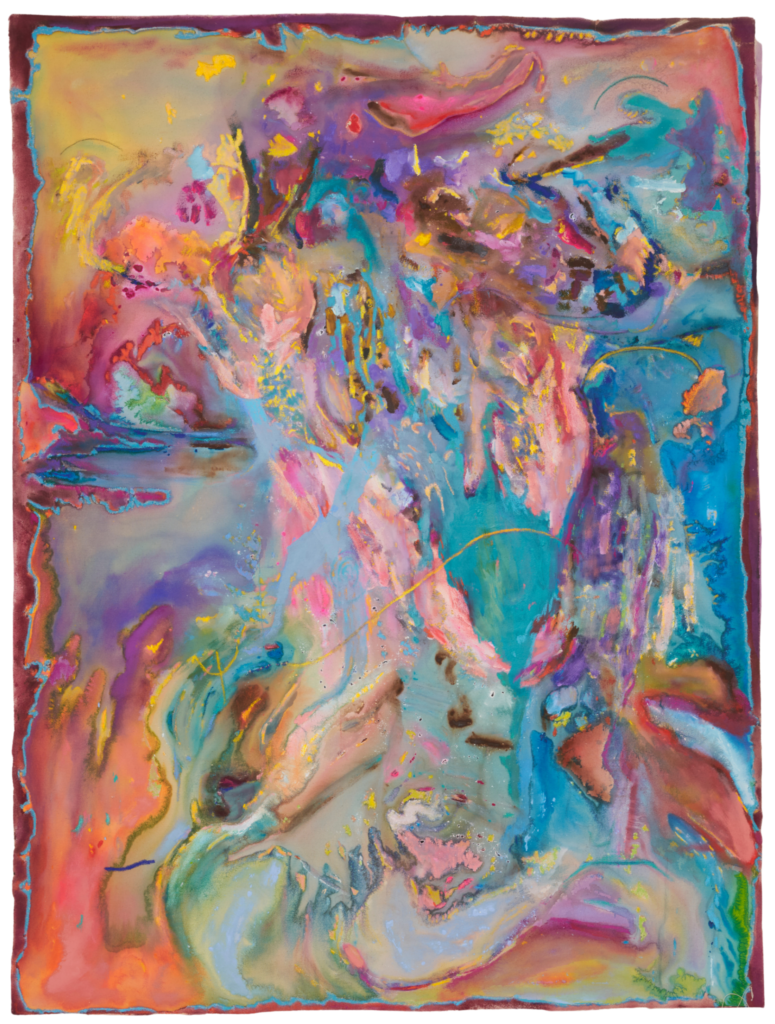
Fragments Toward the Unseen (2024–25) Powdered pigment, oil, oil stick, and acrylic on canvas 160 × 130 cm
The exhibition presents a collection of new, large-scale and small abstract paintings. In A River Inside the Blue, softer smudges of turquoise, cerulean and green are struck through with strokes of purple and peach, while in Fragments Toward the Unseen, pinks and blues bleed into one another like a slick oil spill that has pooled at the edges of the canvas in a deep crimson border.
There is a tension that builds through the layers of paint that Tewelde pours, sprays, and spreads across the surface of the canvases, which begin their lives on the floor; “The process is physical and responsive”, Tewelde explains, “movement is embedded in them from the outset.”
Painting on the floor conjures images of the Abstract Expressionists of the 1950s/60s, namely Jackson Pollock, flinging paint from a tin at overly large canvases. But Tewelde’s approach isn’t fueled by ego but rather by intuition and exploration; “I was always searching for a language that could hold uncertainty, emotion, memory, and perception without becoming overly descriptive,” she explains.
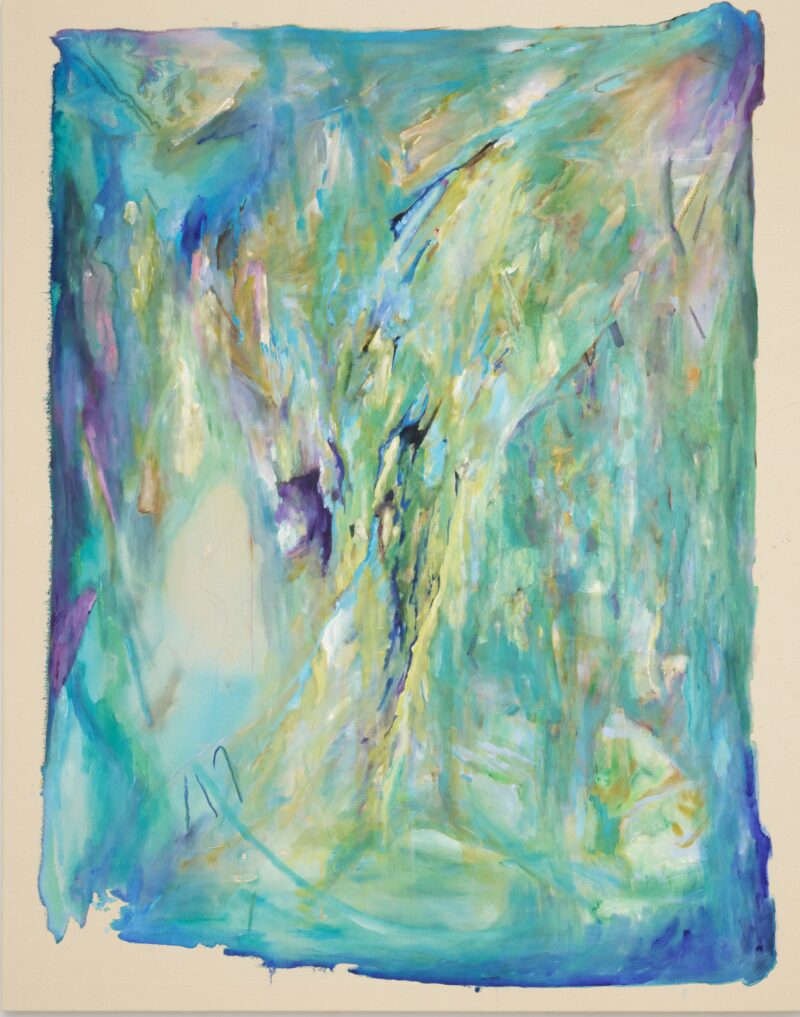
Freya Tewelde, Her Rising Is a River (2025). Powder pigment, acrylic and oil stick on canvas, 130 x 165cm. Image courtesy of the artist and Gallery 1957
Once the groundwork is done, Tewelde moves her canvases to the wall where the process shifts; “I begin looking closely at what has appeared through those initial layers and start recognising forms, tensions, and spatial relationships within the surface. Certain amorphous shapes begin to suggest themselves and become points of focus. From there, the work develops through layering, erasure, and repeated returns to the canvas over days, weeks, and sometimes months,” she explains.
Tewelde describes her practice as psychospiritual; through her process, she explores the relationship between inner experience and the physical act of making: “painting has become a way of engaging with things that are often difficult to articulate through language alone; memory, emotion, intuition, uncertainty, and transformation,” she explains.
Rather than a passive observer, you are encouraged to enter the paintings, which Twelde describes as more akin to an ‘environment.’ The more time spent absorbing the layers and strokes of paint, the more spatial and engaged the experience is. “I’m interested in paintings that can transport us emotionally, where we lose ourselves for a moment in a feeling, atmosphere, or state of perception rather than focusing only on what is visually present,” Twelde says.
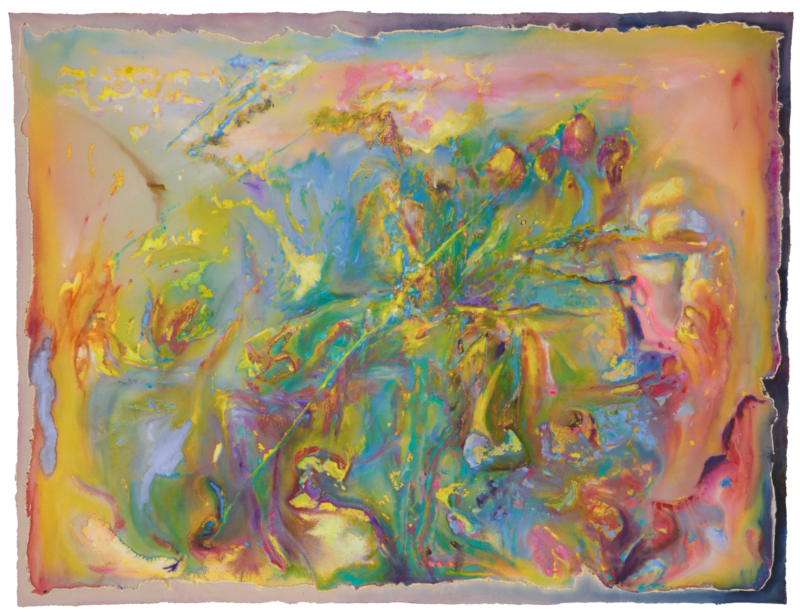
The Weight of Light (2025) Powdered pigment, oil stick, and acrylic on canvas 130 × 170 cm
Pollock said: ‘The modern artist … is working and expressing an inner world – in other words, expressing the energy, the motion, and other inner forces.’ Geometry of Elsewhere transports the viewer to other worlds, an elsewhere that is both familiar and unfamiliar, certain and uncertain, a fluid, shifting yet open dimension.
London Gallery Weekend is a free three-day event where galleries open their doors, present special exhibitions, host events and talks across the city. As part of the weekend’s events, Gallery 1957 will host a special activation for Tewelde’s work, celebrating Eritrean music. Beyond the weekend, Geometry of Elsewhere will be open until 25th July.
by Sadie Pitcher
Exhibition Details
Gallery 1957, London, 1 Hyde Park Gate, London, SW7 5EW
5 June – 25 July 2026