
From Spring Issue 65
Glass Man sits down with British Nigerian actor Toheeb Jimoh to hear about his role in the BBC’s hit series Industry, his love of Shakespeare and how it all began in Brixton
At 28, Toheeb Jimoh has already built a body of work that spans stage and screen, from Shakespearean soliloquy to the high-stakes world of the BBC’s Industry, where he plays trader Kwabena Bannerman in season four. As an actor, he balances the intimacy of theatre with the scale of television and film.
Emmy nominated for his role as Sam Obisanya in the US comedy TV series Ted Lasso and part of a SAG Award winning ensemble, Jimoh has established himself across both mediums, equally at home under the lights of the Almeida as on a film set.
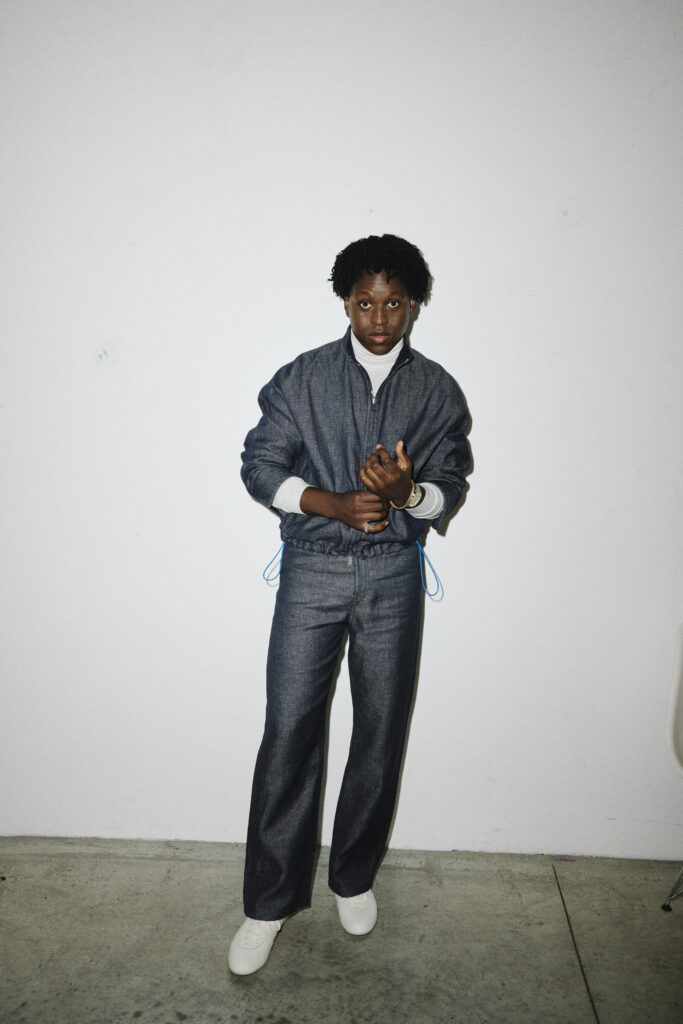
Photographer: Bob Foster
For him, it comes back to craft and collaboration. Raised in south London to Nigerian parents, Jimoh grew up in a diverse, working-class neighbourhood. “I grew up in Brixton in a block of flats on a council estate surrounded by a lot of African Caribbean people,” he says. “And I feel like a lot of my life was really framed by that community. My family are Nigerian, and having a lot of Nigerians and Caribbean people around me growing up was pivotal in becoming the person that I am today.”
He adds earnestly, “When I think back to growing up there, community is the first thing that comes up. It taught me patience. It taught me empathy. It made family and community a huge priority for me.”
Long before nominations and five-star reviews, he was a creative kid, irresistibly drawn to art, music and poetry. “I was definitely more of an extrovert. Early secondary school times, I was writing music, learning to play instruments, drawing a lot. We were listening to music and so inspired by it that we were making some of our own. Writing rap poems, writing songs, short stories. I just wanted to express myself.”
He continues, “It’s funny, I feel like I hear music when I think of myself as a kid. I see art. Creativity has always been a part of my life.”
That wider creative instinct has stayed with him – acting may have become his primary outlet, but writing still hums alongside it. “I’m really interested in writing. I’ve got ideas ticking away,” he interjects. But it was theatre that was the ignition point. “I was lucky enough to go and watch plays at the Young Vic when I was a kid. Watching Chiwetel Ejiofor do A Season in the Congo, I was like, I want to do that. Watching The Scottsboro Boys, I was like, I want to do that. That’s where my love for acting came from.”
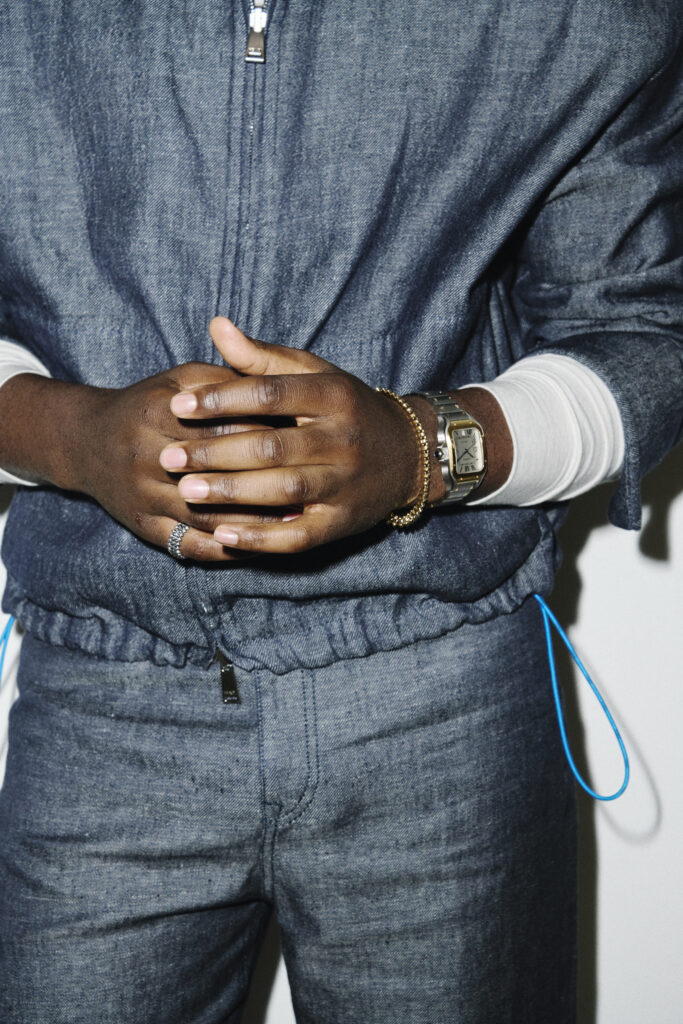
Photographer: Bob Foster
Guildhall School of Music and Drama followed, honing the work ethic he’d built through doing teenage jobs on the side. “Even before I went to drama school, I was so hardworking,” he recalls. “I had so many side jobs as a 15- and 16-year-old, ushering at the Young Vic, working at a school uniform shop and doing playground monitoring.
“At Guildhall, the hours were really long and the standard was very high. It forced me to ask a lot of myself.” Jimoh goes on. “There were some really talented kids who could just do anything by just wanting to do it. I felt like I was someone who had to put more hours in. Stay up. Do the work. And I was rewarded by that.”
His professional life began moving quickly in his final year at drama school with a role in The Feed TV series and a stage debut at the Sheffield Crucible in A Midsummer Night’s Dream. “So much of your anxiety as a third-year student actor is, will I get an agent? Will anyone ever book me? Will I ever become a professional actor? Having a TV show and a play straight away stripped some of that fear away.”
In 2020, his career took on a different weight with Anthony, Jimmy McGovern’s film imagining the life Anthony Walker might have lived had he not been murdered in a racist attack in July 2005. “As soon as I got that job, I was very aware of the responsibility. This is a real person who has real family members who are going to watch this story. It’s a different level of responsibility.” Anthony’s mother, Gee Walker, was closely involved: “She would send us emails, give us her blessing and wish us luck. That stripped some of that fear and imposter syndrome away.”
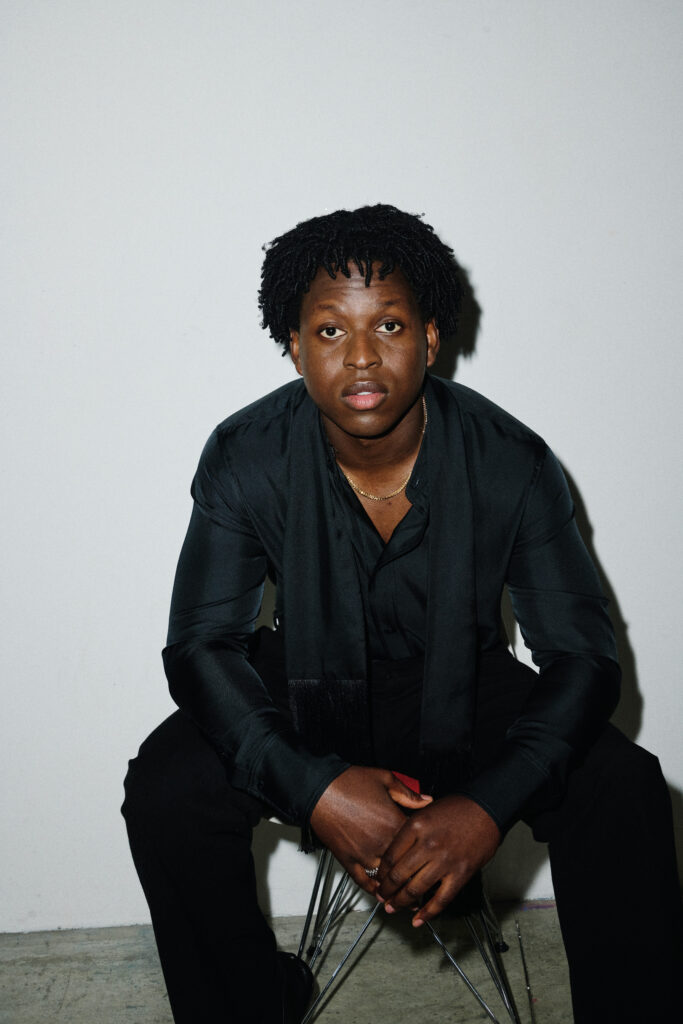
Photographer: Bob Foster
Rather than dwell solely on the tragedy of the story, much of Jimoh’s performance imagined joy: “A lot of my job in that project was bringing the light. His wedding day. His dream job. The birth of his daughter. For the most part, it was finding the light of the possibility of his life.”
That balance of warmth and conviction shaped his portrayal of Sam Obisanya in Ted Lasso, a role that brought him global recognition. Originally conceived as Ghanaian, the character was rewritten as Nigerian after Jimoh was cast, and it grew in prominence over the series.
If Ted Lasso introduced him to US audiences, his recent work in HBO and BBC’s Industry, created by Mickey Down and Konrad Kay, places him in very different territory. Set against the hyper-competitive backdrop of London finance, the series has earned a reputation for its unsparing look at ambition and power. As trader Kwabena Bannerman, he enters a world of financial brinkmanship and moral ambiguity, far removed from Obisanya’s gentleness. “I feel like I’ve done a lot in the comedy space because of Ted Lasso,” he says. “Industry is a drama. But even in that show, I feel like the character I played still brought lightness and levity to a very heavy, dense, stressful world. I’m definitely interested in doing more dramas.”
But as Industry has evolved, so, too, does Kwabena. Beneath the sharp suits and trading floor bravado, he faces something more existential – questions of belonging, ambition and what it means to find your place inside a system that was never built with you in mind.

Photographer: Bob Foster
On whether Kwabena is someone trying to reshape the system or someone who has mastered it, Jimoh’s response is, “Neither. Kwabena isn’t interested in reshaping the system and definitely hasn’t mastered it. I think he’s accepted his place in the system, content to almost sleepwalk through it. The success of the Ghana [work] trip with [colleague] Sweetpea lights a fire in him. I think he’s finding his community in Sweetpea and Harper [another colleague] and a sense of belonging with them.”
The Ghana episode, one of the season’s most talked-about, moves beyond London’s financial battlefield and into questions of identity and heritage. It also blurs the idea of home, “I’m not sure Kwabena regards Ghana as his home and the story bringing him back there brings up complicated feelings. I think it highlights the trade-offs that can happen when assimilating to life as a Black Brit in England – the sacrifices are often ones of language or parents’ language and culture. I’ve found home in all of those things and the community that comes with it.”
Jimoh himself moved to Nigeria as a child before returning to London at seven. Stepping back into a West African setting for Industry, even with filming based in South Africa, clearly struck a chord. It made him think more about where and how stories set on the continent should be told. “I think it’s imperative we tell stories about Africa in Africa.” But he adds, “For me, nothing will beat filming a Nigerian story in Nigeria. The richness and specificity of it only elevates the story and its impact for audiences. I wish we could have filmed Industry in Ghana, I’m sure that level of recognition and authenticity would only engage audiences more. Nigeria has a huge movie industry I’d love to see more Western production companies choosing to shoot there.”
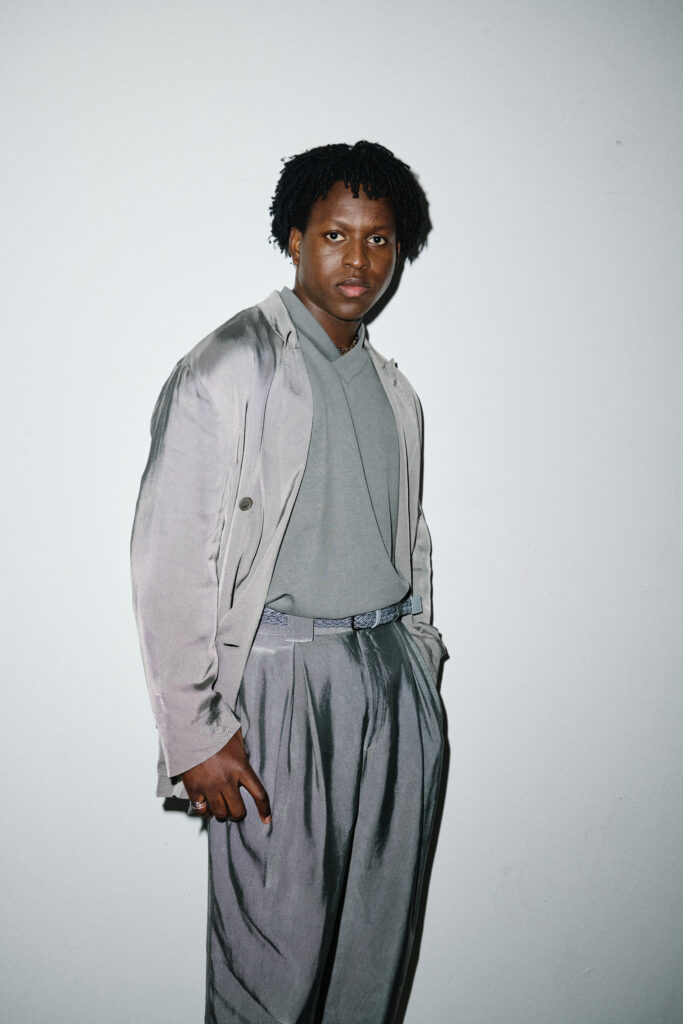
Photographer: Bob Foster
Theatre, especially Shakespearean drama, remains a huge draw for Jimoh. “The stories are timeless,” he reflects. “There will always be young kids in love willing to do dangerous things to pursue this new feeling they’ve found. There will always be people wrestling with what it is to be alive in the wake of grief. His work is bottomless.” What interests him about Shakespeare is how much there is to uncover and how open the work remains, “Even the Shakespeare characters I’ve already played, I could play again and find different things in.”
His approach, first and foremost, is practical: “The first thing to do with any Shakespeare play is to just know what you’re saying. You have to understand the damn thing. Because if you don’t get it, no audience is going to get it.”
Significantly, Jimoh has played Romeo in Rebecca Frecknall’s lauded Romeo and Juliet at the Almeida, and Prince Hal opposite Ian McKellen in Robert Icke’s Player Kings at the Noël Coward Theatre. “It was really hard to say ‘no’ to those jobs. I was desperate to do plays again. They were meaty. There wasn’t enough time in the day to figure out everything Shakespeare had left for you. So I had to rely on what came naturally and navigate my way through.”
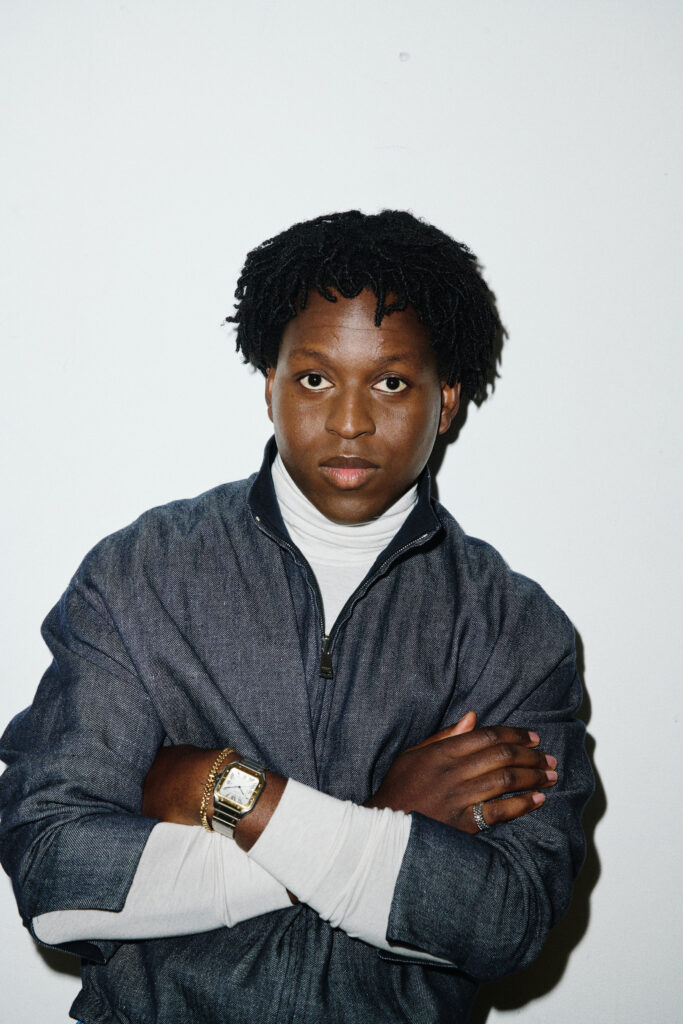
Photographer: Bob Foster
Working alongside figures such as McKellen and Cynthia Erivo has deepened his sense of how a production comes together: “One of the big takeaways I’ve had from working with the likes of Cynthia and Ian is that they’re interested in everything to do with the project. Sometimes as an actor you can become obsessed with your world and your work. But the really great artists are excited about the whole thing.”
That collaborative instinct carries into his upcoming projects. In the film adaptation of Prima Facie, filmed at the Old Bailey and Lincoln’s Inn, he stars opposite three-time Oscar nominee Erivo: “You get into a scene with Cynthia and it feels like it’s just about the work that we’re doing together. They just want to get on with the job.”
And then there’s Clarissa, a contemporary reimagining of Virginia Woolf’s Mrs Dalloway. Directed by twins Arie and Chuko Esiri, Clarissa was filmed in Nigeria. Here, Jimoh stars alongside David Oyelowo, Sophie Okonedo and Ayo Edebiri. Shot on 35mm, the film takes on a softer, more cinematic texture, a fitting choice for a story drawn from Woolf’s interior world.
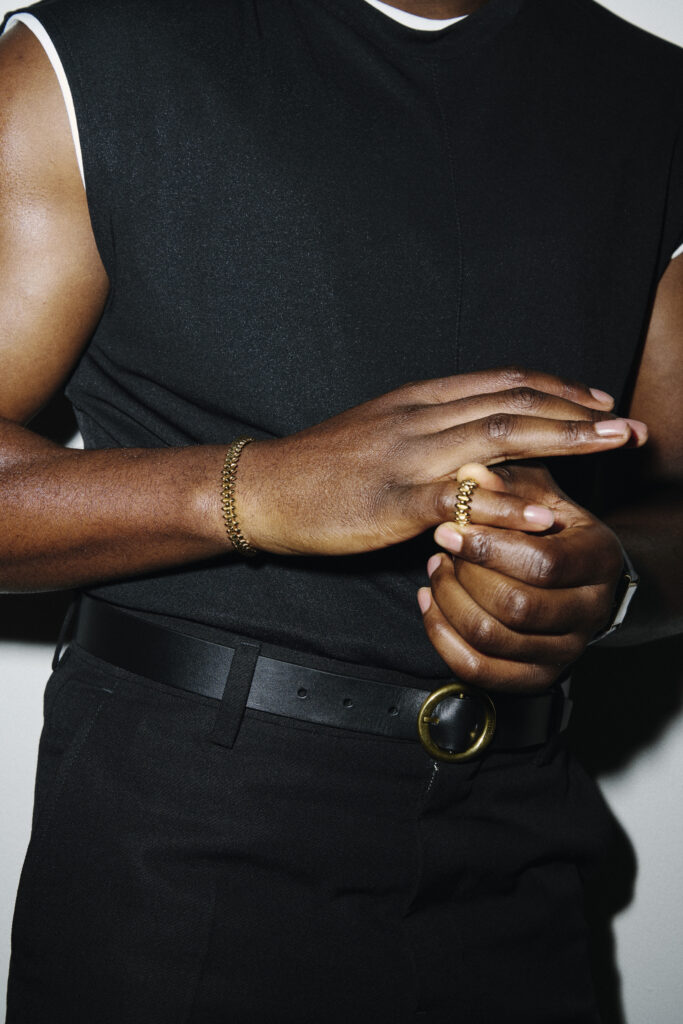
Photographer: Bob Foster
It’s clear the project meant a great deal to him, “It genuinely feels like somebody wrote the perfect gig for me and I got to do it. We shot it in Nigeria and I want to do more work there if possible. The infrastructure is there. It has a booming film and TV industry. There’s a different level of authenticity when you actually shoot Nigeria in Nigeria … It’s going to be so beautiful. I can’t wait to watch it.”
From Brixton bedrooms to Shakespearean drama and Nigerian cinema, for Jimoh it has always been about the craft and the standard he wants to set. “I want to straddle all the mediums. I’ve done a lot of TV, had a good taste of theatre and film is the next frontier.”
And what does he want audiences to take from his performances? “I want there to be a trust between me and people who want to watch my work. I want them to see my name on something and know there’s a certain standard of work they’ll get. They know it’s going to be a good night out and they’ll never be cheated by it.”
by Felicity Carter
Photographer: Bob Foster
Stylist: Itunu Oke
Grooming: Maria Asadi using MAC COSMETICS
Photography assistant: Heather Lawrence
Talent: Toheeb Jimoh
Look 1: Santos de Cartier Large model watch in steel and 18K yellow gold featuring mechanical movement with automatic winding, Clash de Cartier Medium model bracelet in 18K yellow gold, Clash de Cartier Double row model ring in 18K white gold, all CARTIER, Jacket and trousers FENDI, Top UNIQLO, Trainers ADIDAS
Look 2: Santos de Cartier Large model watch in steel and 18K yellow gold featuring mechanical movement with automatic winding, Clash de Cartier Medium model bracelet in 18K yellow gold, Clash de Cartier Double row model ring in 18K white gold, all CARTIER, Jacket and trousers FENDI, Top UNIQLO
Look 3: Clash de Cartier Small model necklace in 18K yellow gold, Clash de Cartier Medium model ring in 18K white gold, both CARTIER, Shirt MITHRIDATE, Trousers MOSCHINO
Look 4: Santos de Cartier Medium model necklace in 18K white gold, Cartier Juste un Clou Extra-large model necklace in 18K yellow gold, Clash de Cartier Double row model rings in 18K white gold, all CARTIER, All clothing ARMANI
Look 5: Santos de Cartier Medium model necklace in 18K white gold, Cartier Juste un Clou Small model ring in 18K yellow gold, diamonds, Cartier Juste un Clou Classic model ring in 18K white gold, all CARTIER, All clothing ARMANI
Look 6: Santos de Cartier Large model watch in steel and 18K yellow gold featuring mechanical movement with automatic winding, Clash de Cartier Medium model bracelet in 18K yellow gold, Clash de Cartier Double row model ring in 18K white gold, all CARTIER, Jacket FENDI, Top UNIQLO
Look 7: Clash de Cartier Medium model bracelet in 18K yellow gold, Clash de Cartier Medium model ring in 18K yellow gold, Tank Louis Cartier Medium model watch in 18K yellow gold featuring mechanical movement with manual winding with a leather strap, all CARTIER, All clothing AMI