
FOLLOWING her first scheduled London Fashion Week debut, demi-couture designer Kanyinsola Onalaja discusses rebirth and design for her latest collection.
Last June, a fire destroyed Kanyinsola Onalaja’s offices, taking with it more than ten years of work. Collections, samples, fabrics, embellishments and the graduation collection that marked the beginning of her career were all lost. For a designer whose practice is rooted in elaborate construction and highly detailed surfaces, the damage was both personal and professional. “Yeah, these are the only remaining archive pieces that we have,” she says. “I even had, like, my graduation collection there. Ten years’ worth.”
During the morning of our interview, Onalaja discovers a bright coral beaded bra among the showroom samples that she did not know had survived. Originally part of a set, it is one of the few remaining pieces from the archive. “Like today, the bra, I didn’t know the bra was here,” she says. “I was really excited to see it. I was like, oh, that’s what I wrote here. So when you get, like, random flashbacks of things, it’s really touching.”
The moment is emotional, but Onalaja is already looking ahead. “But at the same time, it’s like a new beginning, so I’m excited to kind of see how we build in the space.” That idea of rebuilding runs through her latest collection, Rising From The Ashes. First conceived in 2020, the collection was originally based on the phoenix and the idea of transformation. After the fire, the concept became much more immediate.
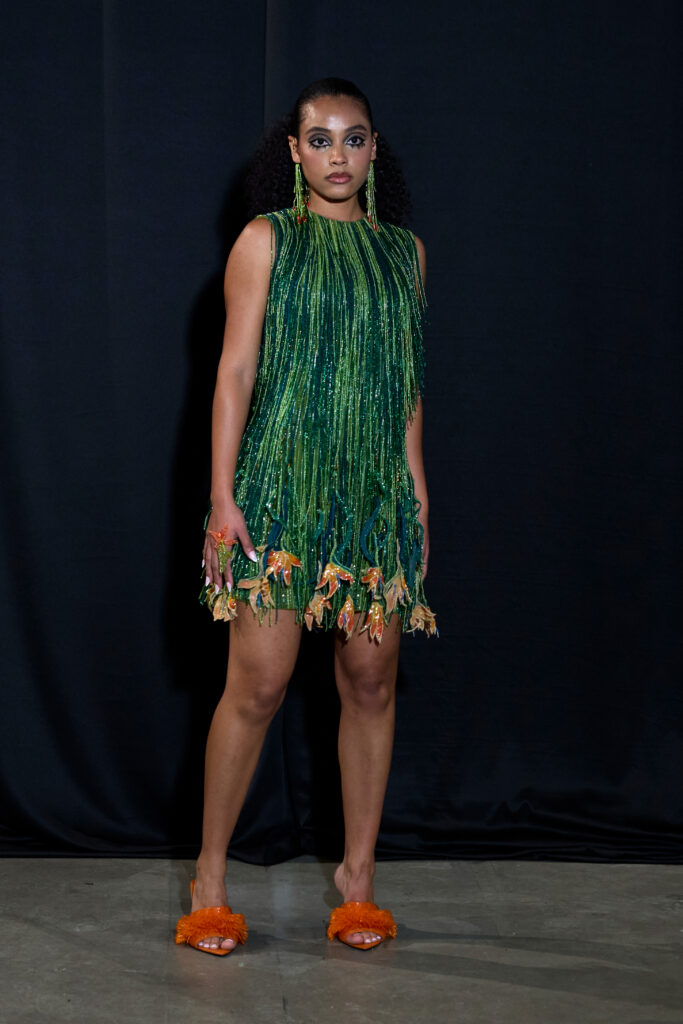
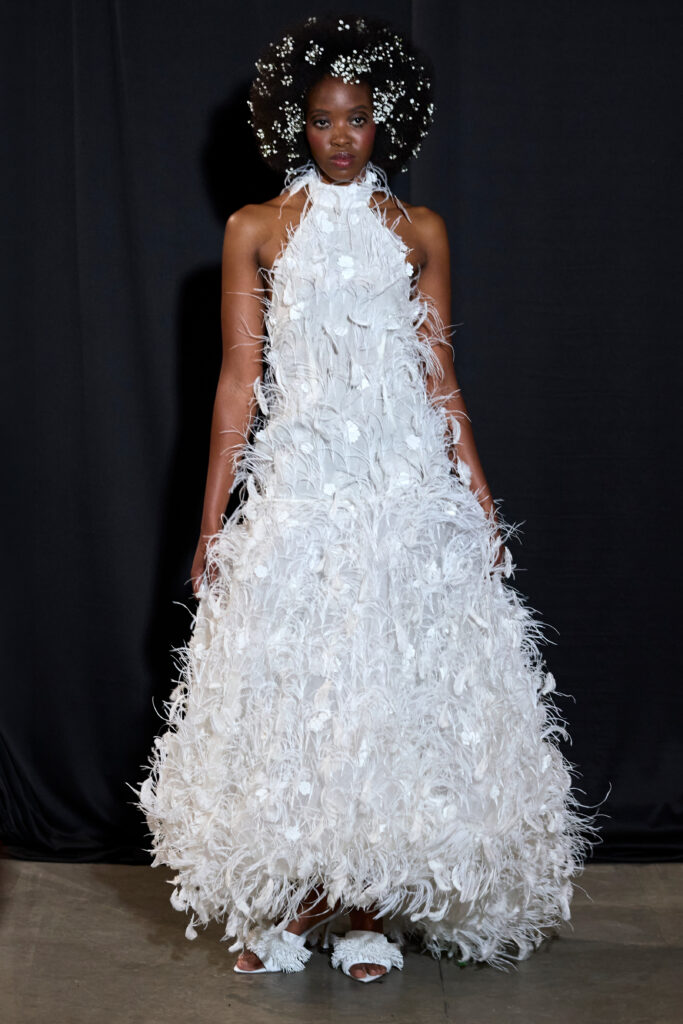
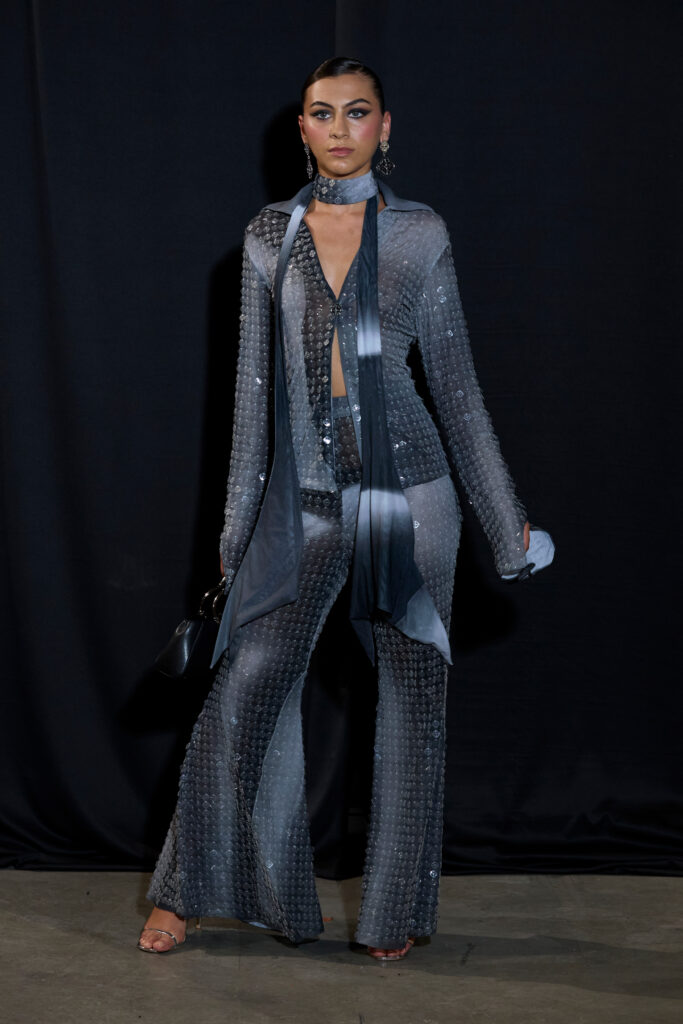
The collection is structured around three stages: The Burn, The Ash and The Rebirth. The opening looks reference fire through ember reds, burnt oranges and terracotta before moving into scorched black and smoky grey. The final section introduces molten gold, iridescent surfaces and brighter colours.
“With the rebirth as well, because, like, it’s like a narrative, so it starts off with pieces that represent fire, then into, like, the darkness, stillness, the ashes, and then the rebirth, purity,” Onalaja explains. “And then it goes to this side of paradise.”
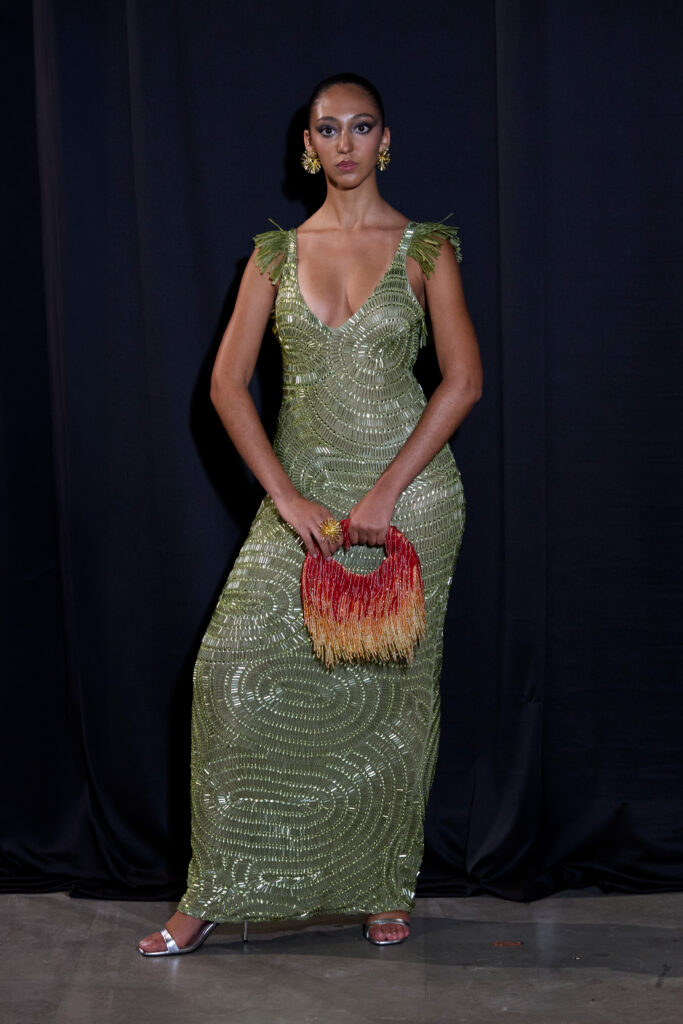
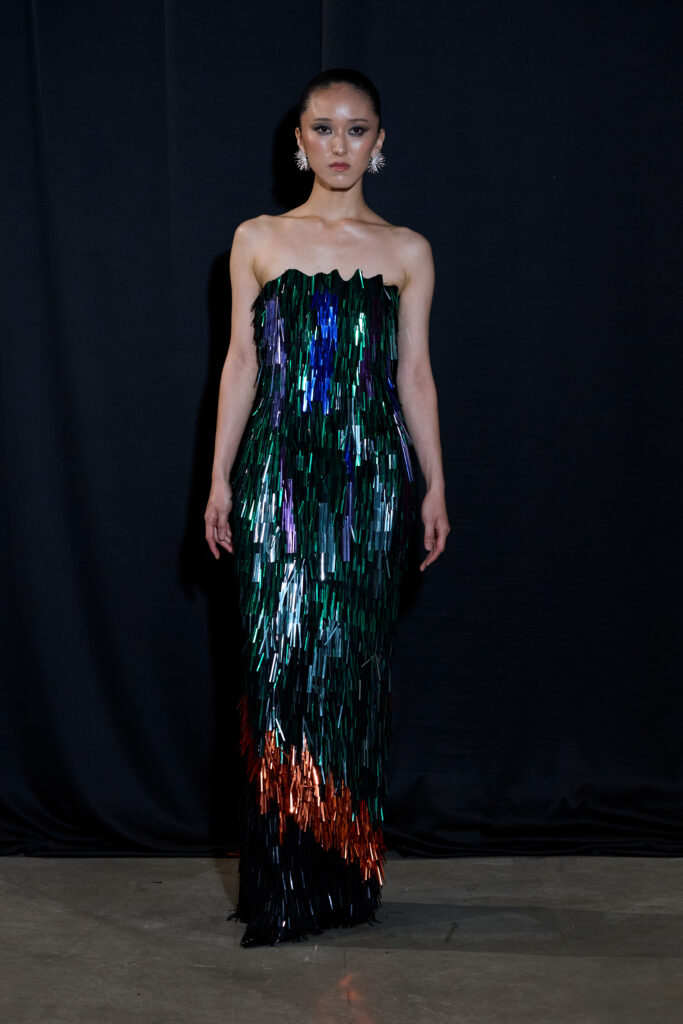
That shift towards paradise is expressed through the collection’s Birds of Paradise references. The flowers bring saturated colour and exaggerated sculptural shapes into the work. Their forms are translated into prints, repeat patterns and three-dimensional embellishment. Onalaja’s process begins with looking closely at the natural world, studying the flowers before transforming their forms into something that can exist on the body. “So, for example, the Birds of Paradise, so I look, study the plants, turn them into artworks with prints, repeat patterns, and then I start experimenting with the beading and making them more three-dimensional.”
From there, the designs develop through layers of beadwork, crystals, embroidery and reflective threads. Some details resemble feathers or scales, while others catch the light like sparks. Beading is displaced, layered and reconstructed across the surface, giving the garments depth and movement. It is an experimental process that gradually brings the initial idea into focus, with the final details eventually finding their place within the silhouette. “Once I’ve done my final original sample, then we match it to a silhouette, and then everything is tangible.”
Onalaja is Nigerian, with Yoruba and Edo heritage. Those influences appear throughout the collection in its patterns, motifs and surface treatments. Her approach is less about reproducing traditional references and more about bringing them into a contemporary fashion language. The clothes become a place where heritage can be interpreted through shape, colour and craft. As she explains, “you have, like, different signs, different [things], so people knew that you belonged to a specific tribe.”
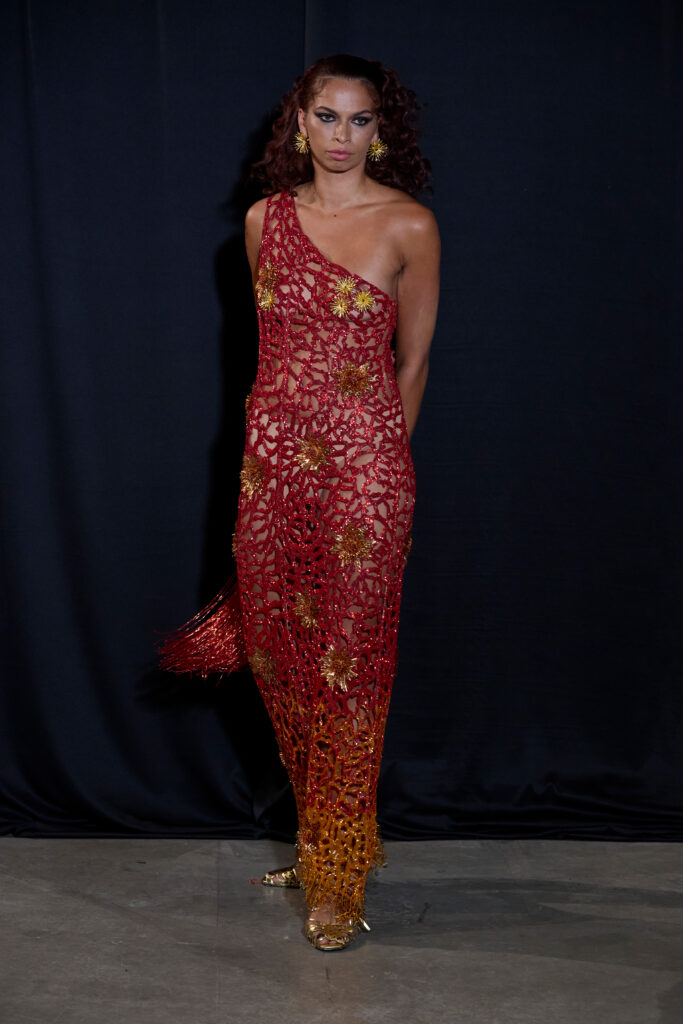
That idea of clothing as a marker of identity is particularly resonant in the use of coral-inspired embellishment. Among the Edo people of the Benin Kingdom, coral beads known as ivie ebo have long been associated with royalty and ceremonial dress, signifying wealth, power, hierarchy and noble status. In Onalaja’s work, the reference becomes more fluid. Coral is not treated simply as decoration but as a connection to heritage and cultural memory, reworked through the language of contemporary couture.
The collection also reflects the designer’s long-standing interest in 1970s glamour. “My silhouettes tend to be, like, very disco glam,” she says. The result is a mix of Nigerian cultural references, sculptural couture techniques and the exaggerated energy of the disco era. These bold silhouettes have captured the attention of stars such as Olivia Dean and Chlöe Bailey, who have worn Onalaja’s garments on the red carpet and on stage.
For the first time, Onalaja has also moved into footwear. The new heels use bright colours and coral-inspired beadwork, with branching forms arranged across the foot to create a blooming effect. The pieces extend the collection’s interest in organic shapes while introducing a new category for the brand.
There is a tension between the collection’s visual excess and the circumstances surrounding it. Onalaja is drawn to beauty, but also to the darker ideas beneath it, including identity, language and trauma. “I kind of like the emergence of something beautiful from this quite dark idea – the trauma of the burning, and how that can become something new.”
This season also marks ONALAJA’s first scheduled runway show since the brand moved its presentation from Lagos to London. The change brings the collection into a different fashion environment, one Onalaja describes as “continually fresh, exciting”. It is a new setting for the brand, but not a departure from its foundations.
Inclusivity remains central to ONALAJA’s identity. The brand was founded to create for women who have often been overlooked by luxury fashion, and Onalaja continues to challenge the idea that high fashion should be reserved for a limited range of bodies. “Apart from being an inclusive brand, it’s what I really try to champion, especially, like, being able to cater to women up to a size XL.” That commitment matters because inclusivity should not be treated as an additional feature of a collection. It should be part of its design from the beginning, reflected in the silhouettes, the casting and the understanding that glamour does not belong to one particular size.
by Ellis Dowle