
MILAN, ITALY — When notes leap to the sky, stories root to the earth. Where classical scores stand still, theatre curves the spine and tilts the body in deep contractions, connecting its fixtures to some primal place of power. Such is the case in Milan’s latest set of works, which saw a breadth of pieces that ooze lightness and depth in equal measure.
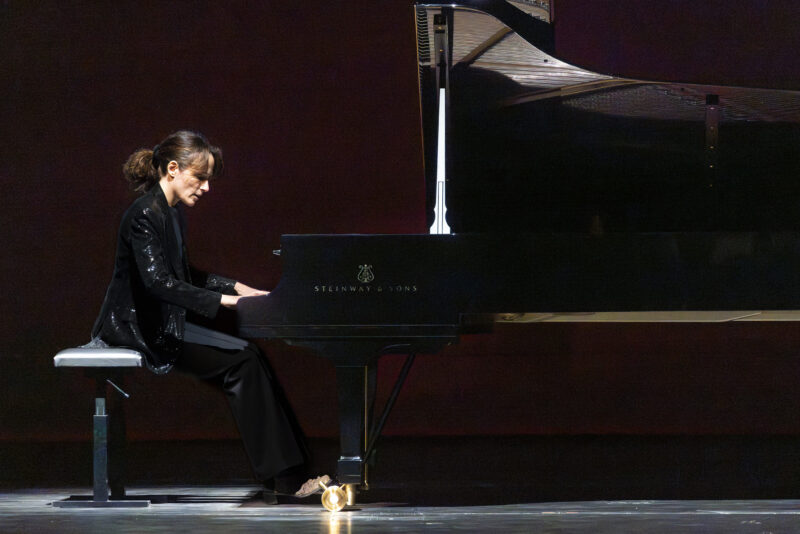
Hélène Grimaud. Photograph: Brescia e Amisano © Teatro alla Scala
March saw the trailblazing Hélène Grimaud at La Scala, with a programme focused on the great German repertoire of the 19th century. The programme opened with Sonata No. 30 in E major, Op. 109, an intimate and familiar work dedicated in 1821 to the nineteen-year-old Maximiliane Brentano, in which Beethoven freely intervened in the formal structure, contrasting the two opening movements with the free development of the imposing theme and variations that constitute the third movement.
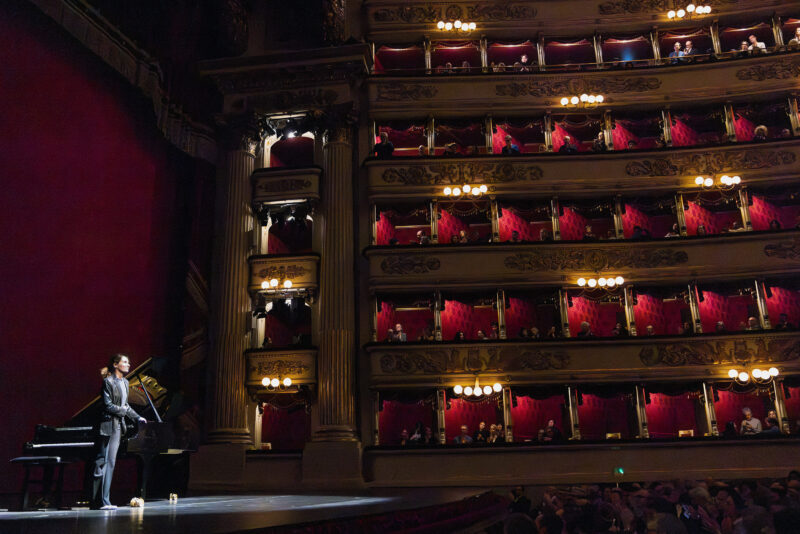
Hélène Grimaud. Photograph: Brescia e Amisano © Teatro alla Scala
Dating from the other end of the century are the Three Intermezzi, Op. 117, with which Brahms returned to the piano in 1896/97 after years of predominantly symphonic activity, finding in it above all an instrument for melancholic inner dialogue. The programme concluded with Ferruccio Busoni’s famous piano transcription of Bach’s Chaconne for solo violin.
The original score, whose exceptional complexity seemed to push the instrument to its limits, had captivated Romantic composers from Mendelssohn to Schumann and Brahms. Busoni’s version captures its rhetorical power and intellectual complexity, bringing the concert to a close with an emotional and spectacular crescendo.
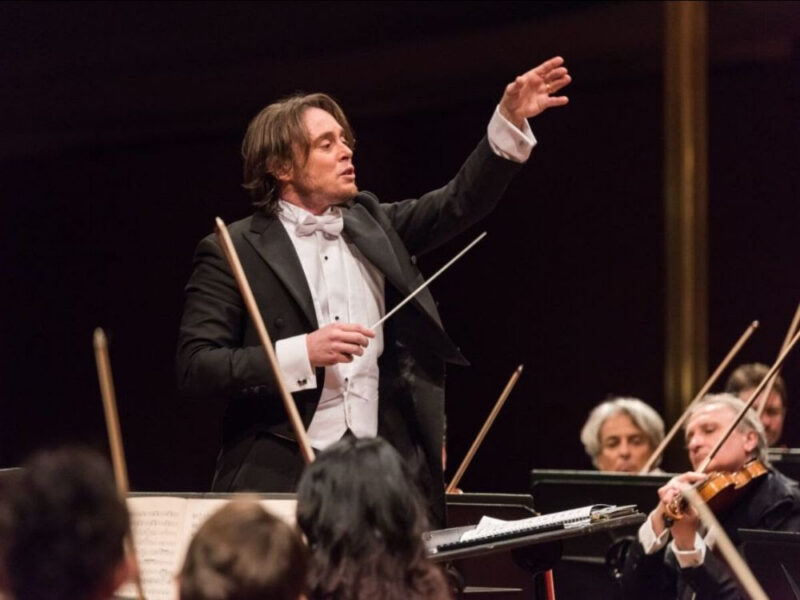
Michele Mariotti
The theatre’s Philharmonic season welcomed Michele Mariotti, one of the leading Italian conductors of his generation and an increasingly frequent guest on the podium at the Piermarini. Mariotti presented a refined programme that paired Wolfgang Amadeus Mozart’s Symphony No. 40 in G minor, K. 550, with Claude Debussy’s Petite Suite in Henri Büsser’s orchestral transcription and Igor Stravinsky’s ballet Jeu de cartes. Through dance, this extraordinary display of virtuosity engaged in dialogue with Mozart and with Debussy’s Petite Suite, a distillation of his compositional art in which one could discover hidden echoes of the slightly later Clair de lune.
Puccini’s Turandot, first performed in 1926 at La Scala, also made a comeback with ten performances in Davide Livermore’s production, conducted by Nicola Luisotti with a cast that featured Anna Pirozzi, Roberto Alagna, Mariangela Sicilia and Riccardo Zanellato, alternating with Ewa Plonka, Angelo Villari, Selene Zanetti and Adolfo Corrado.
Having been staged two years ago as part of the celebrations marking the centenary of Puccini’s death, Turandot returned to the stage of La Scala to mark the hundredth anniversary of its 1926 premiere. The opera ran for ten performances, conducted by Nicola Luisotti and directed by Davide Livermore, who also collaborated on the set design with Eleonora Peronetti and Paolo Gep Cucco, while the costumes were by Mariana Fracasso, the lighting by Antonio Castro and the video projections by D-Wok.
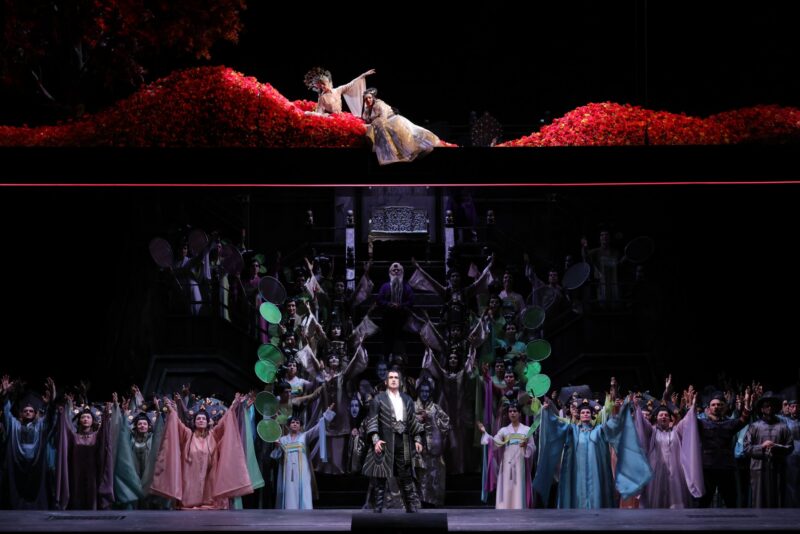
Turandot. Photograph: Brescia e Amisano © Teatro alla Scala
Turandot, left unfinished upon the composer’s death in 1924, was first staged on 25 April 1926 at La Scala, conducted by Arturo Toscanini and featuring a finale by Franco Alfano, which was also used in this production. At the premiere, Toscanini interrupted the performance upon Liù’s death, laying down his baton and uttering the words.
Maxime Pascal and Romeo Castellucci bring Pelléas et Mélisande back to La Scala after over two decades. This marks Castellucci’s debut at La Scala, as well as his first new opera production for an Italian theatre. The cast includes Bernard Richter, Sara Blanch, Marie-Nicole Lemieux, John Relyea and the return of Simon Keenlyside.
To mark the occasion, the theatre and the publishing house Il Saggiatore will present two new publishing projects. Claude Debussy’s Pelléas et Mélisande returns to La Scala until the start of May, 118 years after its legendary La Scala debut with Arturo Toscanini, and anticipation is sky-high, certainly due to the work’s long absence but above all because of the excellence of the performers.
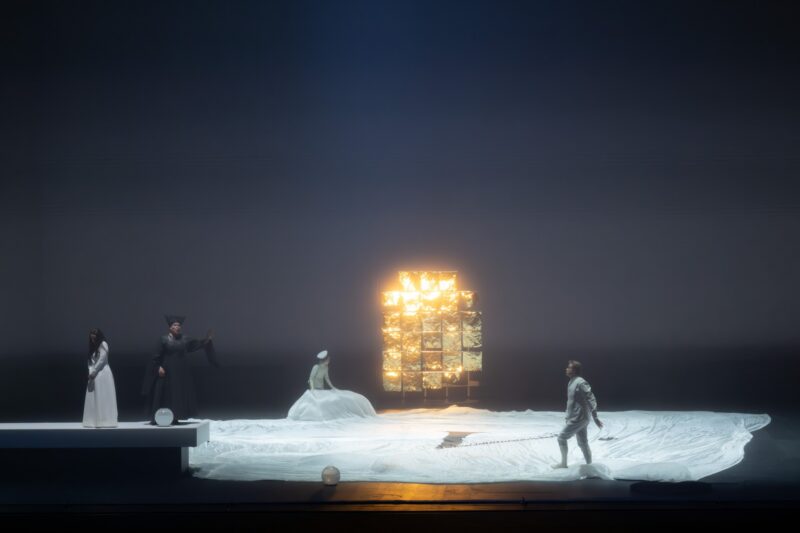
Pelléas et Mélisande. Photograph: Brescia e Amisano © Teatro alla Scala
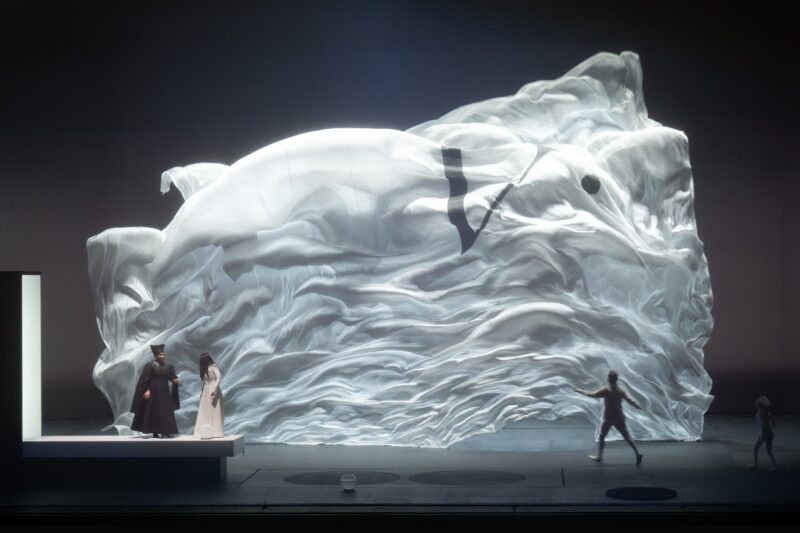
Pelléas et Mélisande. Photograph: Brescia e Amisano © Teatro alla Scala
Maxime Pascal, a forty-year-old conductor who, after making an extraordinary contribution to the revival of contemporary music, including conducting works by Sciarrino and Francesconi at La Scala, has become a regular guest at the Salzburg Festival, the Paris Opera and the Musikverein in Vienna, this year joins the musical ‘triumvirate’ at the helm of the Deutsche Oper in Berlin.
This year, as part of its season, the Filarmonica della Scala will host the Tonhalle-Orchester Zürich at La Scala on Monday, 11 May at 8 pm, alongside its music director Paavo Järvi and the Spanish violinist María Dueñas. Born in 2002, Dueñas makes her debut at the Piermarini with Erich Wolfgang Korngold’s Violin Concerto in D major, Op. 35. Korngold, a composer of the early 20th century, incorporated many melodies from the Hollywood films he had worked on into this piece.
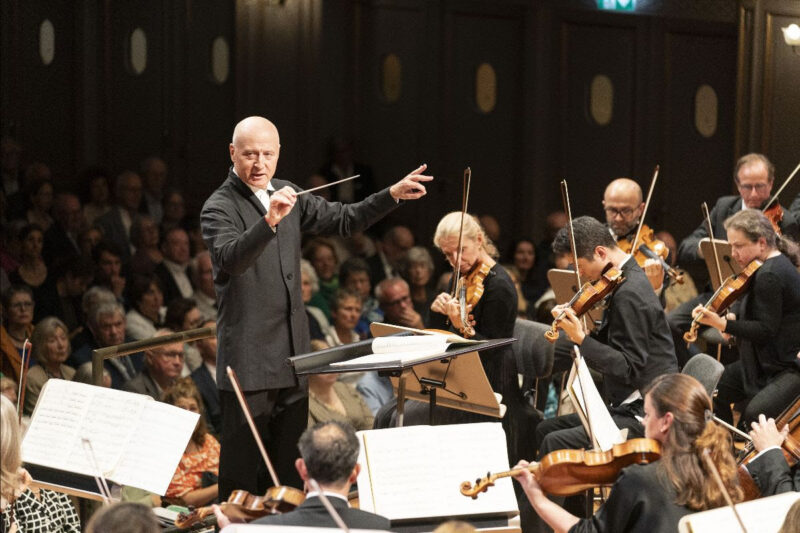
Tonhalle-Orchester Zürich
In the second half of the concert, Järvi will conduct Pyotr Ilyich Tchaikovsky’s Symphony No. 5 in E minor, Op. 64. Paavo Järvi is one of the most sought-after conductors of his generation. Alongside his commitments with the Tonhalle and the Deutsche Kammerphilharmonie Bremen, he will take on the role of artistic director of the London Philharmonic Orchestra from the 2028/29 season.
May will also see the debut of French conductor Marie Jacquot, at the height of a career that has taken her to the podiums of Europe’s leading orchestras, alongside violist Antoine Tamestit. The programme features the Overture from Der Freischütz by Carl Maria von Weber, the Overture and Suite Op. 61 from A Midsummer Night’s Dream by Felix Mendelssohn-Bartholdy, and the Concerto for Viola and Orchestra by William Walton.
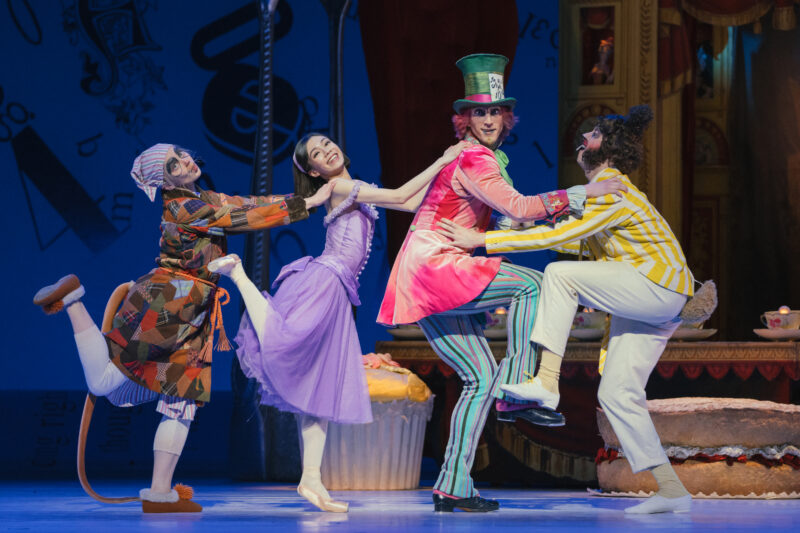
Artists of The Ballet in Alice’s Adventures In Wonderland. Photograph: Karolina Kuras. Courtesy of The National Ballet of Canada
Alice’s Adventures in Wonderland premieres in Milan in May. A co-production between the Royal Ballet and Opera and the National Ballet of Canada, it first premiered at the Royal Opera House in London in 2011. A huge success since its creation, Alice’s Adventures in Wonderland established Christopher Wheeldon as one of the most interesting contemporary choreographers for his ability and originality in engaging and entertaining audiences through a modern narrative ballet, described by many as almost ‘a modern-day classic’, in which classical technique blends with contemporary sensibility.
An explosion of colour, innovative and sophisticated choreography, imaginative and breathtaking costumes and sets, from puppets to projections, and a score that combines contemporary soundscapes with sweeping melodies reminiscent of 19th-century ballets all contribute to its appeal. With Alice, audiences are swept up in a myriad of adventures and encounters. The extraordinary and instantly recognisable characters from Lewis Carroll’s books allow the performers to shine in a variety of styles, while also paying homage to the great 19th-century ballets.
by Chidozie Obasi