
From Autumn Issue 63
Glass Man talks to Austrian actor Felix Kammerer about his forthcoming film, Frankenstein, working with Guillermo del Toro and the fine line between man and monster
Somewhere in a small town outside of Hamburg, Felix Kammerer is trying his hand at rowing. “I’m shooting now and this is a dream set,” he says, showing me the lake behind him. “We’re shooting on rowing boats and trying to make it look as good as possible, without, you know, drowning.”
For Kammerer, this is just another day of filming. What he’s possibly unaware of is the fact that his life is about to take a turn once the work in progress, Frankenstein, is released, a turn potentially even more career-defining than All Quiet on the Western Front.
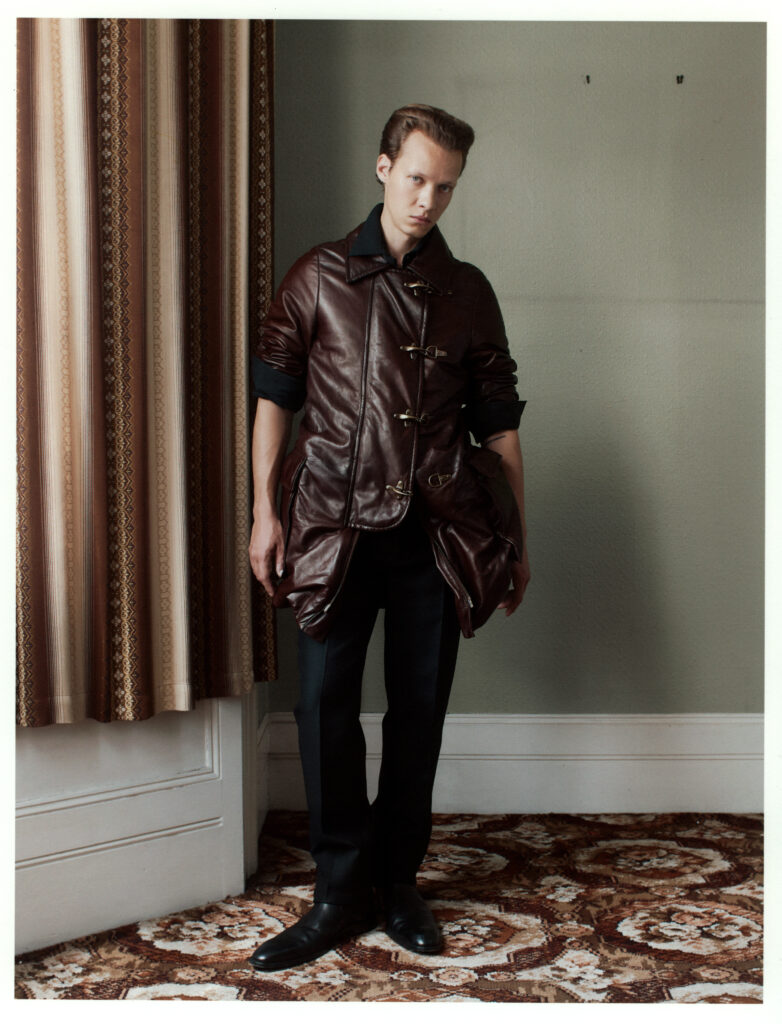
Photographer: Keir Laird
The 29-year-old Viennese-born actor grew up in a household attuned to performance. His parents, Hans Peter Kammerer and Angelika Kirchschlager, are renowned opera singers. Educated at the famous Gymnasium Wasagasse, he developed an early interest in theatre, joining Vienna’s Junges Ensemble Hörbiger before refining his craft at Berlin’s prestigious performing arts university, HfS Ernst Busch, from which he graduated in 2019.
Kammerer swiftly made his mark on German-speaking stages, performing at the Deutsches Theater Berlin, the Maxim Gorki Theater and the Salzburg Festival. His work at Vienna’s Burgtheater, where he became a member of the ensemble, cemented his reputation, with roles in Don Karlos, The Magic Mountain and Schwarzwasser, among others.
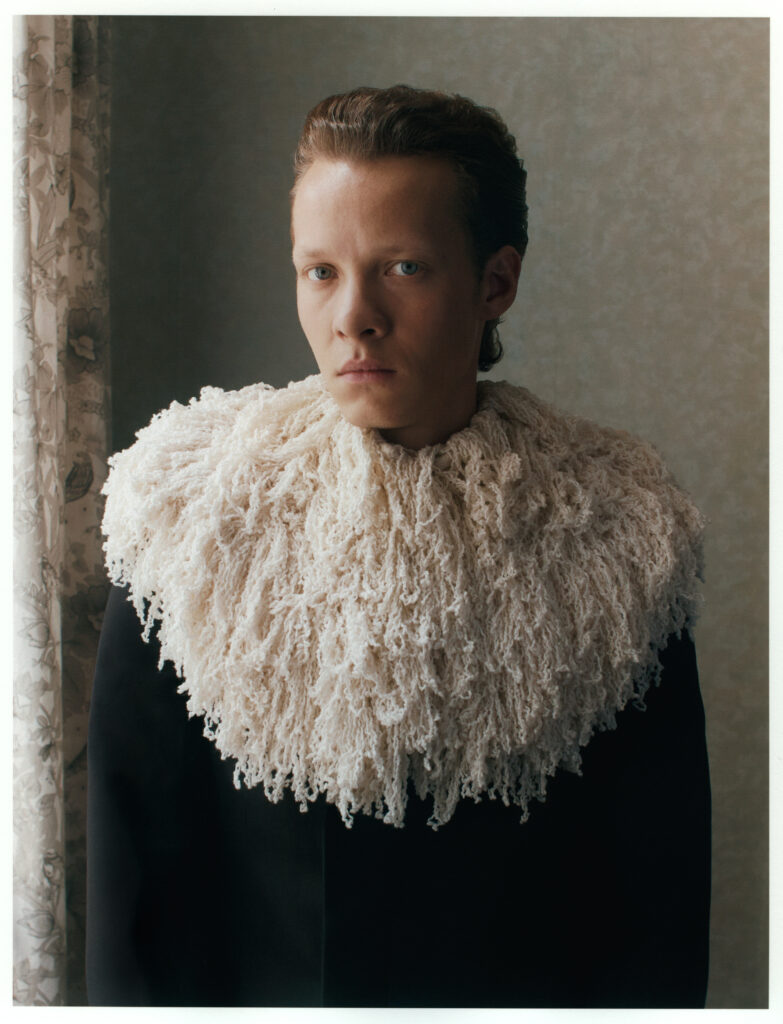
Photographer: Keir Laird
International recognition followed with his screen debut as Paul Bäumer in Edward Berger’s German language adaptation of All Quiet on the Western Front (2022). Kammerer’s unflinching portrayal of a young soldier destroyed by war helped propel the film to four Academy Awards. In the same year, he received Austria’s Nestroy Theatre Award for Best Newcomer, highlighting his growing success across both stage and screen.
Kammerer now stands on the threshold of a new chapter. Chosen by Mexican filmmaker Guillermo del Toro for Netflix’s Frankenstein, due for release in November, he joins a cast that includes Jacob Elordi as the Frankenstein monster, Oscar Isaac, Mia Goth and Christoph Waltz.
Kammerer takes on the role of William, Victor Frankenstein’s younger brother and ultimately the catalyst for the storyline. But what exactly made Del Toro choose him? “People don’t know how cleverly he works with casting and he knows exactly what he wants, who he wants, and why he wants those people,” Kammerer begins. “He told me he saw something in my eyes when he watched All Quiet On The Western Front and he also wanted that quality in William; the quality of these eyes, whatever he saw there. And then, yeah, a few months later, I found myself in Toronto and we started shooting.”
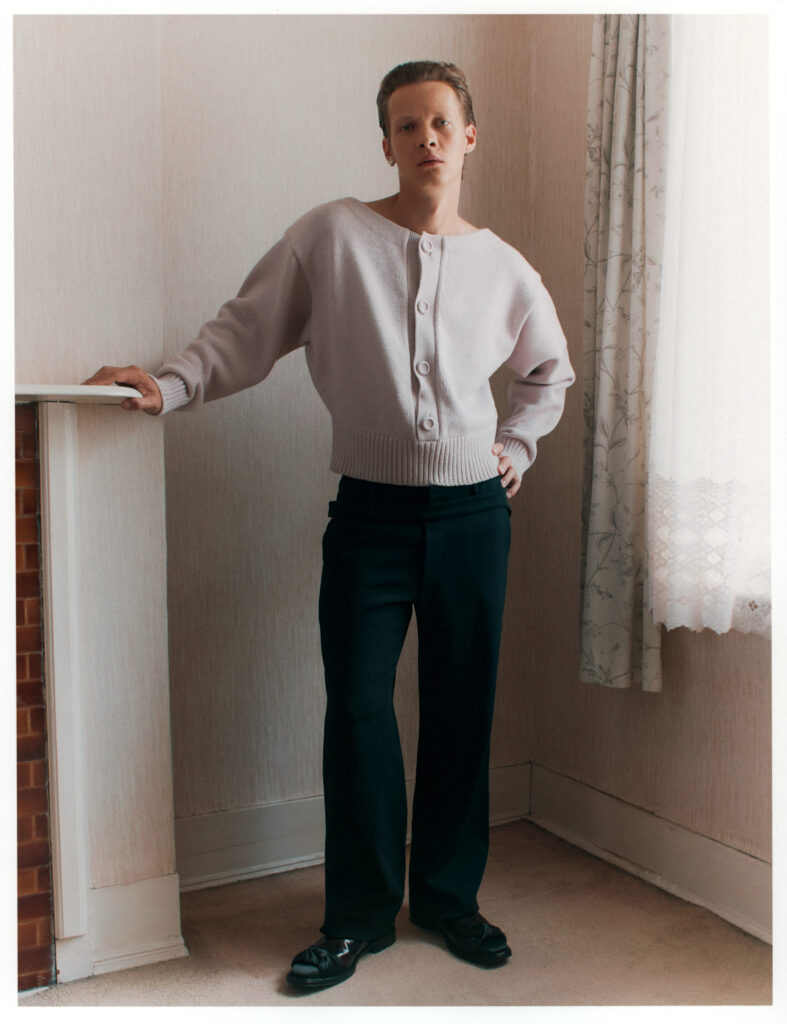
Photographer: Keir Laird
It’s easy to presume that serendipity played a part. Or was it Del Toro’s mind that was already tuned into a vision that he’s held for decades? Ultimately, the young actor was hand-picked for the role in a very literal way. “We met for the first time at the Oscars. I was walking down the aisle on my way to the bathroom and suddenly a huge hand just grabbed my shoulder, and I thought, ‘Oh my God, what’s happening?’ And he turned me around. He said, ‘Kid, when are we going to work together?’ And I said, ‘Well, you are Guillermo del Toro. You tell me.’”
Del Toro is known for his grandeur, whether that’s in ideation or sheer production scale, as Kammerer quickly discovered himself. “When I arrived in Toronto, they took me straight to the base for a costume fitting,” the 29-year-old actor recalls.
“We drove towards the harbour, because that is where the studios are, and I thought, ‘Oh look, there is this ship’. I assumed it must be some kind of training vessel brought in by sailors for a marine class. Then I arrived on set and realised it was a full-sized sailing ship built in the middle of a car park, mounted on a gimbal so that the whole ship could move. It was absolutely gigantic. It wasn’t in the water; it was just sitting there in the parking lot. You had the rows of Prius cars and then this enormous ship, basically parked there.
“When you see that for the first time, when you see the studios, the sets, the ship and the make-up that Jacob [Elordi] went through, sometimes for as long as nine hours, you know you are working on a Del Toro film.”

Photographer: Keir Laird
We’ve all heard the rumours – about the intensity of the filming schedule and how Del Toro reframed the narrative – yet there’s still a veil of mystery around what will make his Frankenstein stand out. “There might be no other person on this planet to understand Frankenstein better than Guillermo del Toro because he wanted to make this film since he first read the book when he was 16,” Kammerer continues.
“He put a lot of different influences into the film, from different versions: Frankenstein’s Bride, from the Boris Karloff films, those versions from comic books and from the novel itself. So, I think when people watch it, they will notice that there are parts in the film that maybe very few people really know because they’re so new. They come from a very specific, small part of the novel, just maybe one sentence, and he made a whole scene out of it.”
Frankenstein tackles dynamics as old as time. We’re looking at family dynamics, father-son relationships, rivalry, jealousy, pain, inner child wounds – all taking the form of a single euphemism, the Creature. What was Kammerer’s way into the chaos of it all? “If you have a person like Guillermo del Toro by your side, even moments you don’t understand on set will make sense later. When you go into a studio for ADR, re-recording your lines because of sound issues, you see the scene for the first time in a little snippet and you realise, ‘Ah, that’s why he wanted me to do it that way’. You don’t see that on set. You just have to trust the process, trust the person and be open. Basically, like Frankenstein, don’t try to put it in a box. Together, you build the box.”
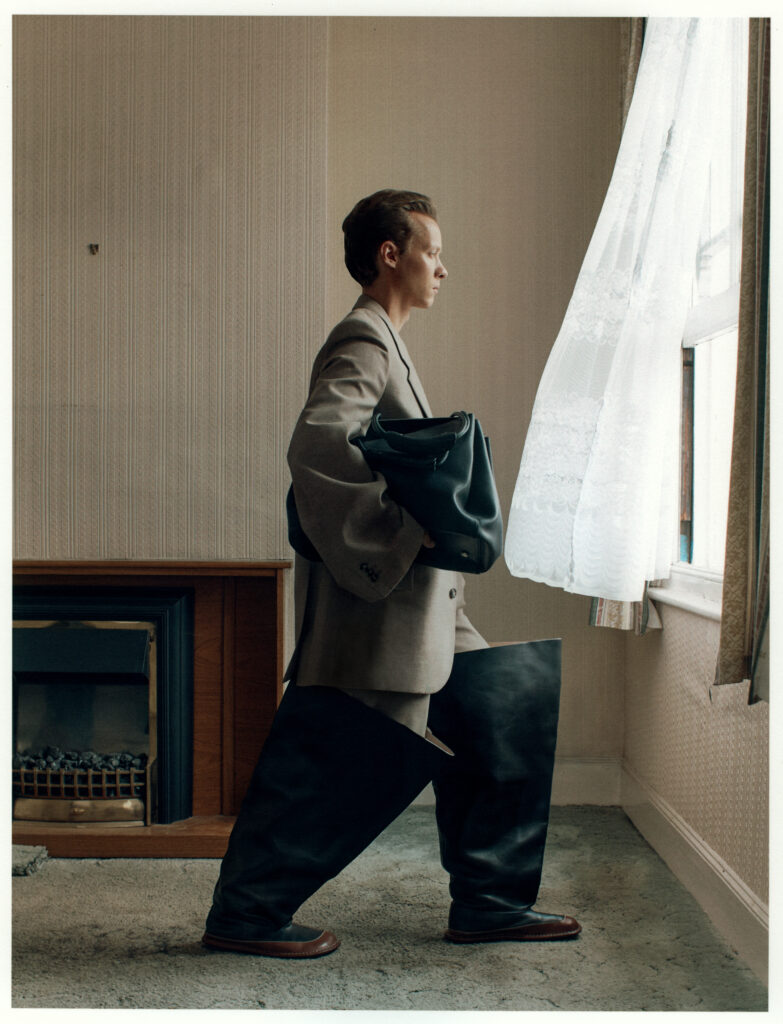
Photographer: Keir Laird
As for William and Victor’s dynamic, the topic is complex, yet Kammerer found a way to simplify it. “You have quite a lot of different approaches in that relationship,” he explains. “William is the younger brother, which is always an interesting topic between siblings. It brings up the age gap. Who has been on Earth longer, who has more experience but also who is favoured by the parents?”
But such polarity is both what makes and breaks relationships. William was ultimately the catalyst for the storyline, the man who provoked the Creature into such a degree of jealousy that the ending was inevitable. “In William’s and Victor’s case, William is favoured because he is the wonderful son, the lovely son who is very successful in finance. He is successful with people, he is intelligent, quick-thinking and he can put that into the world to his advantage.
“Victor, on the other hand, is not very well adapted. He just does things his own way, and if people do not understand, that might be a problem for him because he cannot persuade others to understand him. He is not very diplomatic. Those two characters are destined to clash with their family history, with their relationship, with their wishes and with their hopes. They need each other to understand what they are doing, but at the same time, it is the catalyst that brings fire to the whole inferno in the end.”
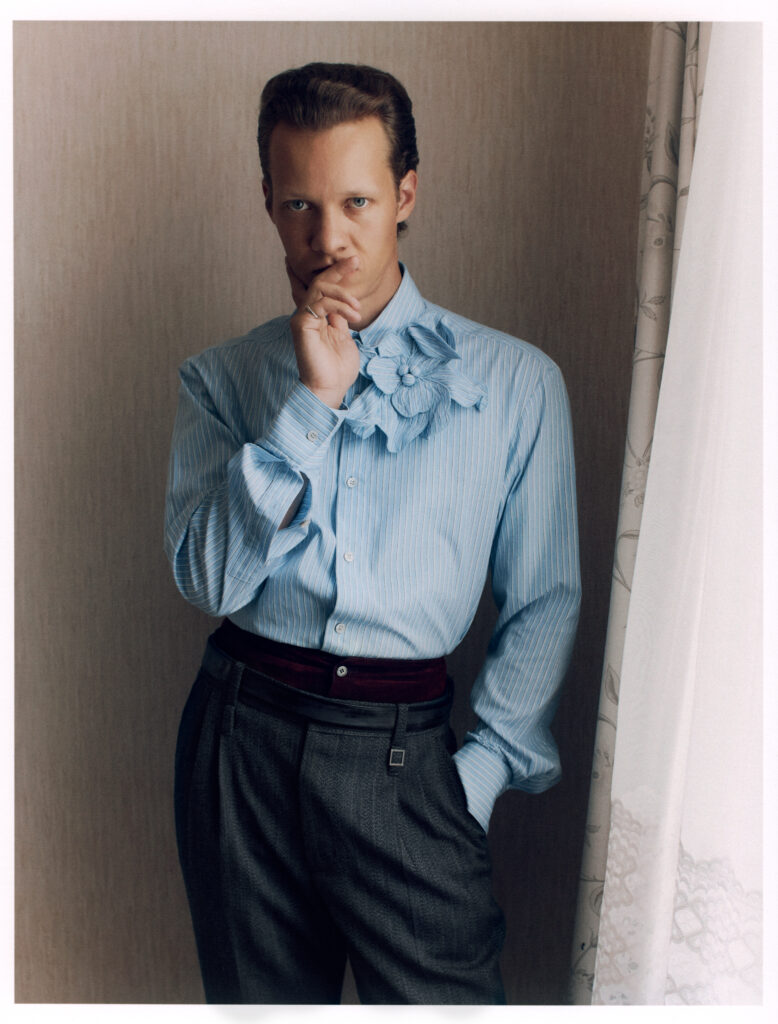
Photographer: Keir Laird
Frankenstein turns the mirror towards the parents when the children are in distress. Victor’s relationship with the Creature mirrors it. However, it’s difficult to pinpoint the logical reasoning. Human nature defies logic. “It’s this weird mixture: I create the demons that I never wanted to wake, but also something grows over my head and becomes maybe even better,” Kammerer says. “And then this Oedipus thing. You try to do everything you can to not make the prophecy happen, and by trying that, you just enable the prophecy to become reality. Parents try to make things better, but sometimes, just by doing that, they make it worse,” Kammerer concludes.
What about the Creature? Is it worth vilifying an archetype of pain that translates into aggression? “The Creature is certainly one of those characters that really takes a deep dive into the topic of fathers and sons, of children and parents, but at the same time, you can project so much more onto the Creature in a metaphysical, transcendental way that offers more than what you read on the surface.
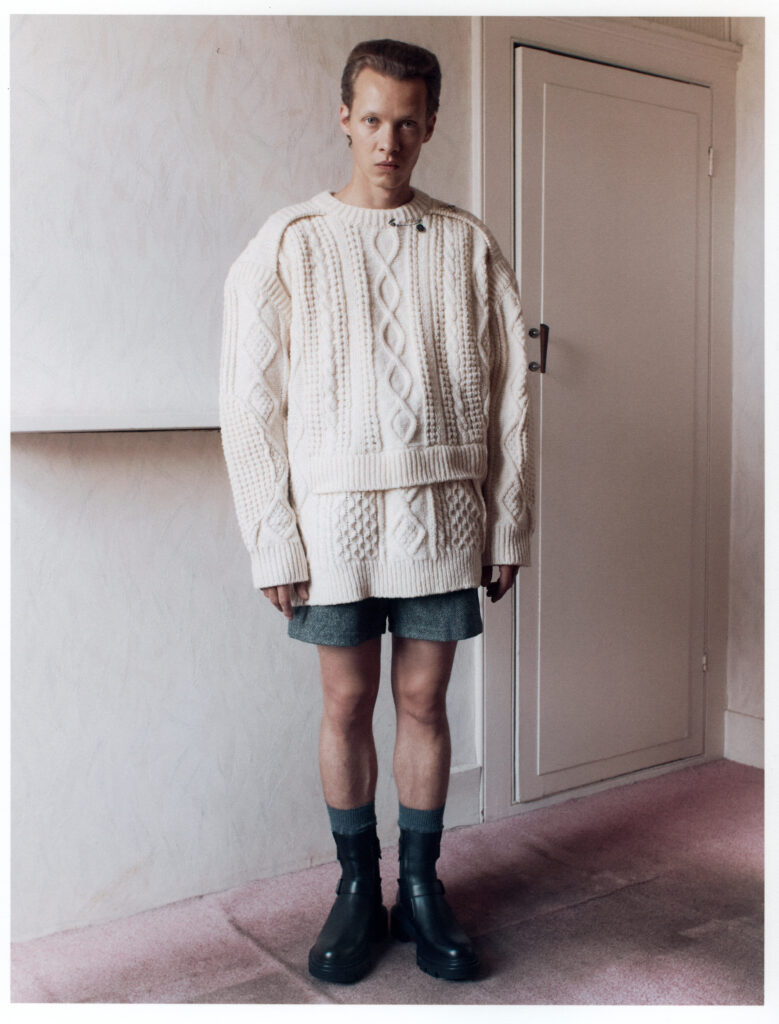
Photographer: Keir Laird
“In a different universe, the Creature could be something untouchable, like a digital character, some AI version that you created, which then takes its own path, and you do not understand why. You try to keep it small, to bring it back into the box, but it is already out there, and you cannot control it any longer. So, it also has a great deal to do with powerlessness, but also with power, with what you can control and what is simply beyond your control.”
So who’s the real monster in the storyline then? “There is this wonderful sentence from the film,” he replies. “‘Only monsters play God’.’”
by Adina Ilie
Frankenstein is in select cinemas 17th October and on Netflix 7th November
Photographer: Keir Laird
Senior Fashion Editor: Lily Rimmer
Grooming: Brady Lea Using Tatcha
Producer: Lucy Banfield
Production: Rosco
Photography assistant: Grace Tasselli
Styling assistant: Ellis Dowle
Talent: Felix Kammerer
Look 1: LOEWE
Look 2: EGONLAB
Look 3: Cardigan, shoes and earring DIOR MEN, Trousers BIANCA SAUNDERS
Look 4 & 5: LOEWE
Look 6: Shirt, long johns and trousers WOOYOUNGMI, Ring BUNNEY
Look 7: Jumper GIVENCHY at DESIGNER EXCHANGE, Shorts GEORDIE CAMPBELL, Brooch Ara Vartanian, Socks PANTHERELLA, Shoes CHRISTIAN LOUBOUTIN