
Glass Man discovers how Stone Island has translated its legacy of innovation, research and culture into stores bearing their own unique aesthetic with OMA / AMO
For more than 40 years, Stone Island has operated as a laboratory just as much as a fashion house. From its home in Ravarino, Italy, to the global stage, the brand has defined itself through a preoccupation with material alchemy, turning technical fibres into cultural armour. President and CEO Robert Triefus explains that the brand exists in the tension of a dual reality: the rigorous research and development of the “Lab” and the organic subcultural “Life” of the community that wears it.
To translate this legacy into a spatial language, Stone Island partnered with Samir Bantal and OMA / AMO to reimagine retail as a sensory “alphabet” of industrial materials. Moving away from the brightly lit tropes of traditional luxury, their new retail concept favours burnt cork, industrial Tyvek and heavy-hitting archival objects.
Here, Triefus and Bantal discuss the intersection of community and research to define an architectural “recipe” that prioritises discovery over transaction. In an era of hype aesthetics, Stone Island and OMA / AMO are proving that the most powerful luxury isn’t found in a logo but in the technical integrity and restless development of the material.
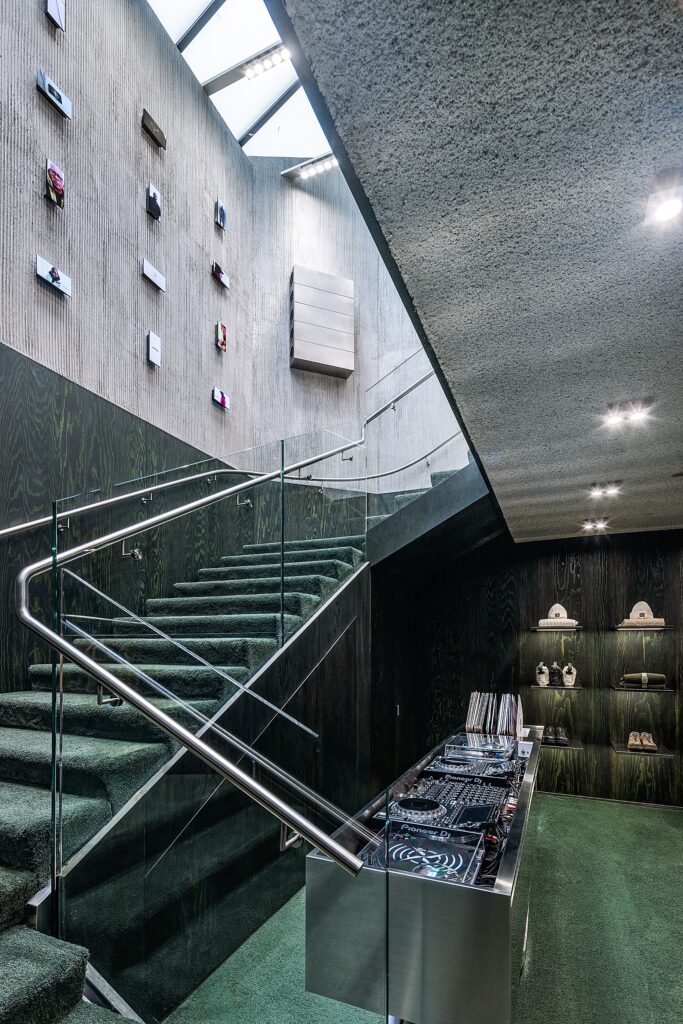
Stone Island New York Flagship by Bridget Beyer
Robert Triefus, Stone Island President and CEO
You have previously mentioned that the Stone Island community is a form of research. Do the stores act as a space where you can observe and learn from how people wear the brand?
The starting point with Stone Island is that over its 40-odd-year history, it’s had a unique journey because the founder, Massimo Osti, was approaching the product starting from the function, and the material research.
The community built itself, very organically, around those innovative propositions. Over time, Stone Island has really been based upon different kinds of subculture. In the beginning, there was a more style-related community called the Paninari in Milan – young kids who wanted to look cool and Stone Island was one of the brands that ended up in their wardrobe. Then there was an organic transition into the football community followed by a segue into music, particularly grime and hip hop. Subsequently, the brand has transitioned into other subcultures in music and art.
Community as form of research is about observing people from different cultural backgrounds. Philosophically, it’s fascinating – the notion of research comes from both the lab side of the brand and from the life, or community, side.
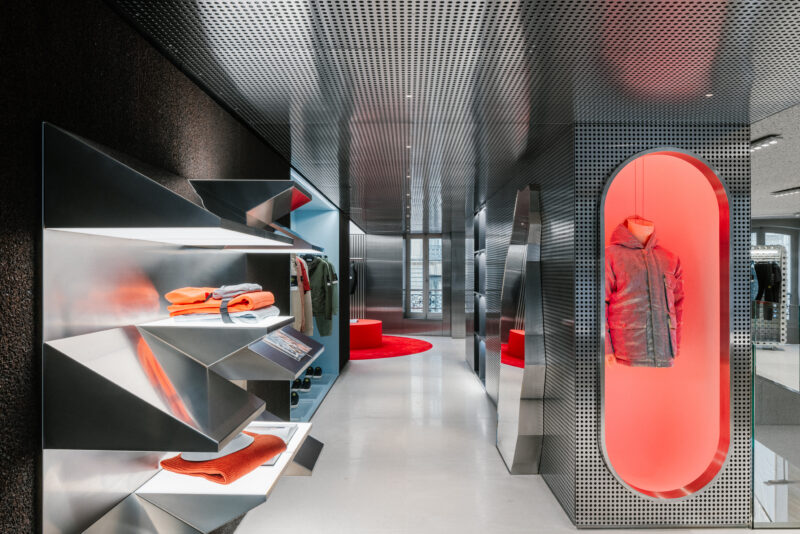
Stone Island Paris by Benoit Florencon
Have you noticed a difference in how people interact with the stores that you didn’t see in more conventional retail layouts?
When developing the store concept with Samir and AMO, it was about delivering something authentic. First, you have to go to Stone Island’s home in Ravarino and immerse yourself in the founder’s vision; the research and development, the Tintoria, the archive, the ground-breaking materials. Samir came away with the idea of using innovative materials for the retail experience and taking the concept of unusual materials from apparel into retail.
The most recent store in New York speaks to exactly that. We found an interesting way of creating an intimate experience at the end of a journey, because when you get into the store, at first you experience a more fast-pasted environment, more similar to a ‘classic retail space’, and then, as you get into the store, you find elements like a design DJ booth and audio system, a bar, where clients can really enjoy themselves on a more experiential level. This is a perfect example of the brand research in all of its forms, not just when it comes to materials, but also about the experience we are able to convey.
In the stores, you and OMA / AMO have used materials like cork and soil. Was the goal to recreate a specific environment?
Stone Island has long been defined by its spirit of experimentation—transforming and treating materials in ways that give them unexpected functionality. Massimo Osti’s first unusual fabric was treated tarpaulin. Using burned cork and soil continues that tradition, creating unexpected sensory experiences. Natural hues evoke the natural world, while technology in the stores, like screens and chandeliers, add contrast, engaging visitors and bringing storytelling to life.
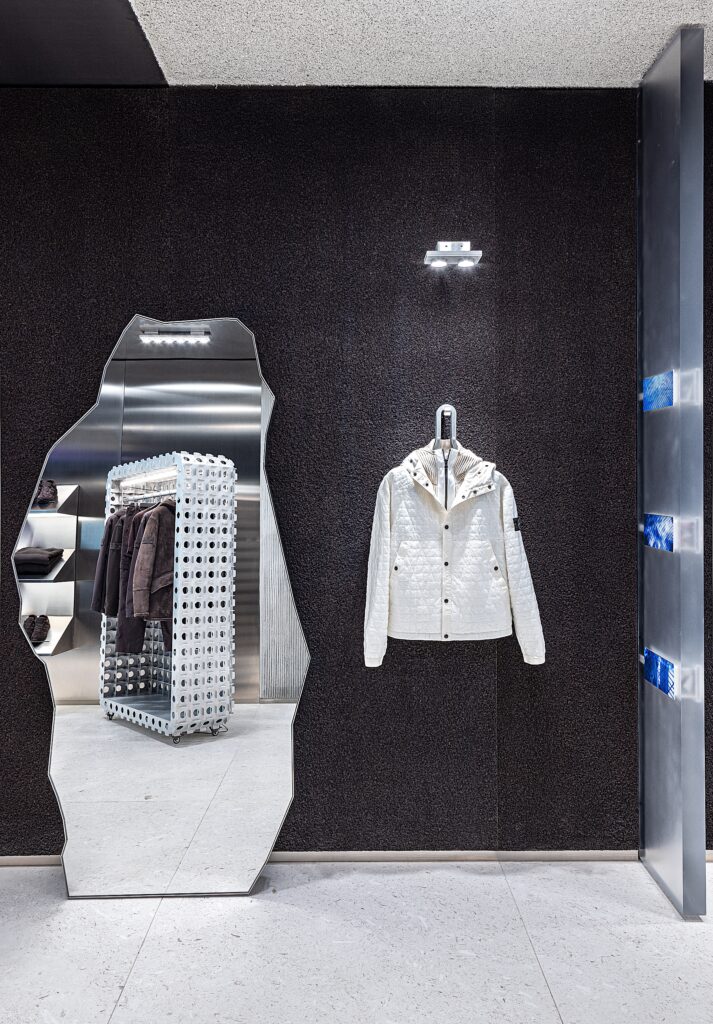
Stone Island New York Flagship by Bridget Beyer
While there is a global architectural language to the space, you have incorporated each city’s subculture into the design of the stores. Is there a particular one that stands out to you in capturing the spirit of the city’s community?
We focus on “lighthouse” cities: among others Paris, New York, Shanghai and recently Hangzhou. I find Hangzhou very interesting for its inner contradiction: it is one of the oldest cities in the world, yet home to Alibaba. Our store there very much reflects this duality; it’s within a historical location, but still we were able to create a destination for a young, tech-driven local community. It respects the city while serving today’s culture.
By suspending the “Chandelier” screen display and clearing the floor, you can turn a Stone Island store into a multi-functional space. What is the most memorable cultural moment you’ve seen happen in that space that had nothing to do with selling clothes?
We’ve had several performances. Charlotte Day-Wilson debuted her album, Takuya Nakamura, a Japanese DJ, played the trumpet during his set, Sam Gallaitry performed and Dave exhibited part of his Stone Island archive with vinyl releases. These moments unfold organically and are true to the Stone Island community.
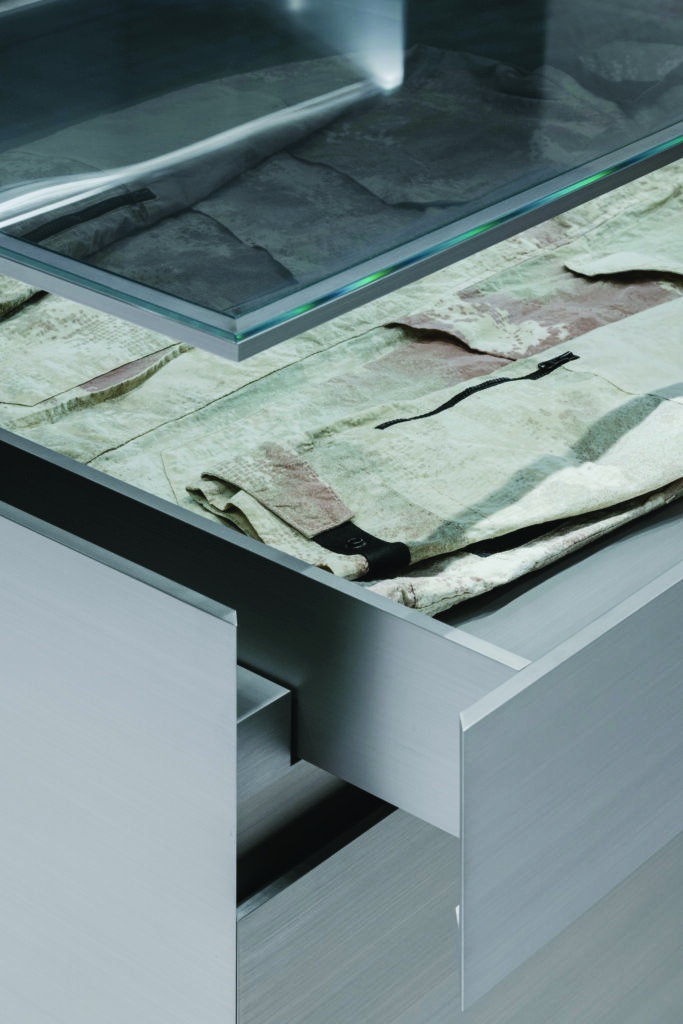
Stone Island Store Vienna by Benoit Florencon
You have a 40-year-old archive in Ravarino that is almost sacred. How do you and OMA / AMO translate that feeling of living history into a modern store concept without it feeling like a dated museum?
The Stone Island archive is really unique. You get a sense of legacy and forward-looking vision. In the stores, we include one archive item that resonates with the current collection. It’s not just history, it points toward where the brand is going. Clients can relate that archival piece to today’s collection. Collaborations, like with Kim Jones at Dior Men, show how the archive inspires modern design without feeling dated.
With such a vast archive, how do you choose what pieces to bring into the light of a modern store?
We select items that align meaningfully with the current collection, showing continuity without feeling historic or static.
Since you have stepped into the role of CEO, what do you feel has been the most significant shift in the direction of the brand?
Stone Island is evolving. The community is growing. Europe is our historical market but we’re expanding in America and to China. The brand appeals to all ages – from 60-year olds to their children. It’s a brand that travels and remains true to itself, finding new communities worldwide.
You’ve navigated the world of legacy luxury before. What makes Stone Island unique compared to anything else you’ve led?
Its capacity to evolve while staying true to its DNA. Connecting past, present and future makes it unique.
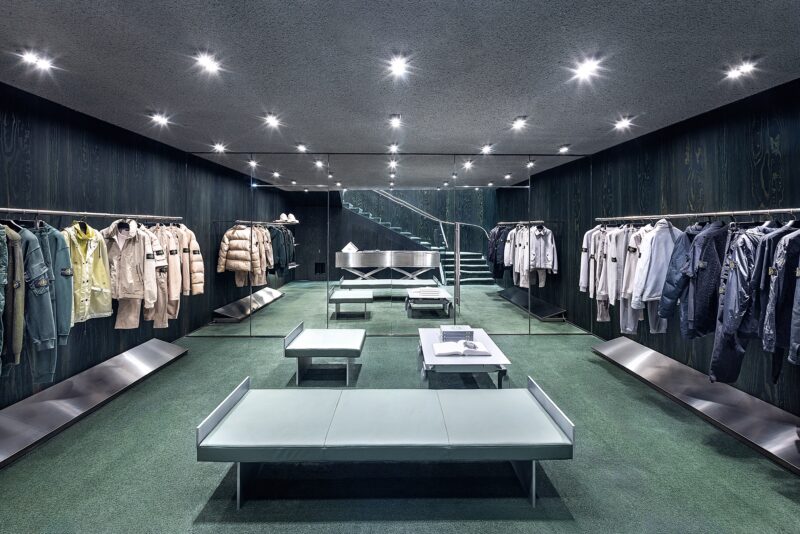
Stone Island New York Flagship by Bridget Beyer
Samir Bantal, Director, AMO
Beyond the aesthetic of the store, you have put a lot of focus on acoustics and touch. When someone walks into a Stone Island space you’ve designed, what is the first sensory note you want to hit them?
Everyone has an opinion about architecture, especially in retail where there is such a high demand for sensory experience, even though it is usually reduced to the visual. The approach started in 2022 when the Stone Island team told me they were looking for a new concept for their retail spaces, a kind of brand architecture.
I responded with an analysis of the brand rather than telling them how to organise their stores. For me, the essence of Stone Island is rooted in research and material development, and that’s how I approached the spaces. They needed to be built around a language of materials. From there, you create a palette that is recognisable and deeply connected to the brand.
When people enter the stores, they immediately see the importance of material. We used cork, for example, in unexpected ways on walls. The texture has a strong identity, but the moment you touch it, you realise it feels warm, not cold like concrete or stone. It’s natural. That tactile shift is important.
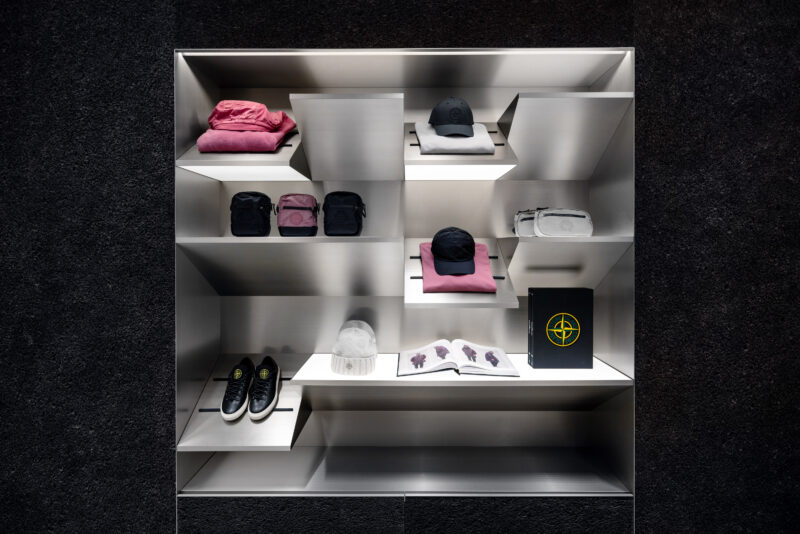
Stone Island Galaxy Macau
You have referenced Joseph Wright’s 1771 painting, The Alchemist, as an anchor for the Stone Island project. How did you translate that 18th-century chiaroscuro atmosphere into a contemporary system that favours experimentation over traditional fashion statements?
After our first meeting, I asked if I could visit their Headquarters in Ravarino. You always need to look in someone’s kitchen to understand who they are. I didn’t want to think from a retail perspective. I wanted to think from their brand perspective – to understand Stone Island as an entity.
We walked through the Tintoria in Ravarino. It’s in the Italian countryside and in the distance you can hear Ferraris and Lamborghinis being test-driven. In that same landscape, you have the Stone Island lab and dyeing facility, where technicians in white coats develop highly specific colour recipes for each material.
They begin by creating colour ranges before designing the clothes. Then they figure out how to apply one colour consistently across entirely different materials. If you want a jacket in a single shade, that’s far more complex than assembling it: the zipper, the outer shell, the lining all react differently. It requires endless treatments and constant testing.
To me, it felt like modern alchemy. That process of experimentation and control had to be translated into architecture.
Your most recent Stone Island space in New York features a secluded nook and a speakeasy-style room. Why was it important to create these moments of intimacy?
Community is central to the brand, especially through music events and gatherings. Creating a space where that community could meet, whether for a seasonal presentation or a specific concept, felt essential.
Each store has a different configuration, so you have to respond to what’s there. In New York, there was a smaller room downstairs that reminded me of a speakeasy. The challenge was designing something that functions as a store during the day but can transform into a more intimate environment.
We tested the idea of being surrounded by a completely different material downstairs, and it worked. It creates a sense of intimacy that feels just as comfortable for a group as it does for two or three people. Traditional high-end retail is often designed around speed. We wanted to slow that down.
The further you move into the store, the slower the process becomes. The downstairs space allows people to take their time, and it can be closed off entirely to become private – a space where one or two people can explore the clothes without pressure.
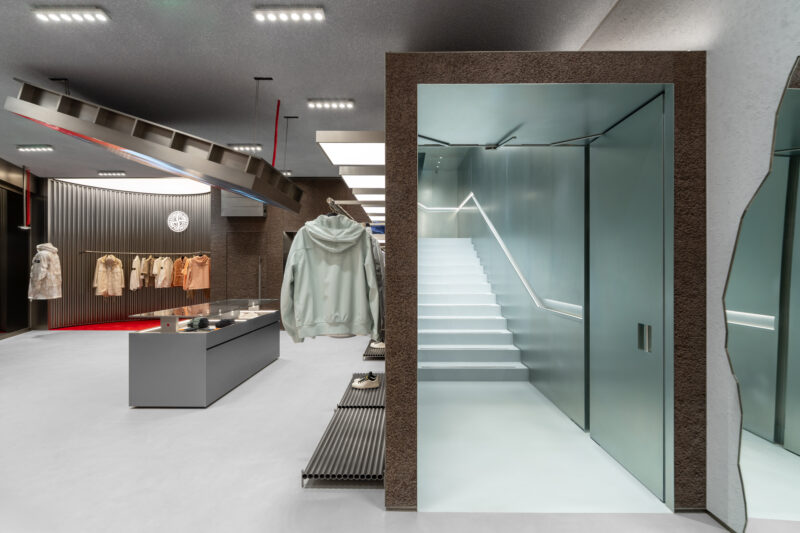
Stone Island New Hangzhou Flagship
One of the most striking aspects of the design is the use of simulated weight — turning cork into marble-like panels or paper into concrete. What were the biggest technical hurdles?
You can sell Stone Island products anywhere, but architecture is different. Cork, for example, is accepted as an interior material in some regions but not in others.
We had to develop a kind of recipe. If we produced a material in one region, we needed to be able to reproduce it elsewhere. The cork comes from Portugal and was shipped to Italy, where a company sandblasted it to create a specific texture, so that later a colour layer is added. That process had to be documented so it could be replicated globally.
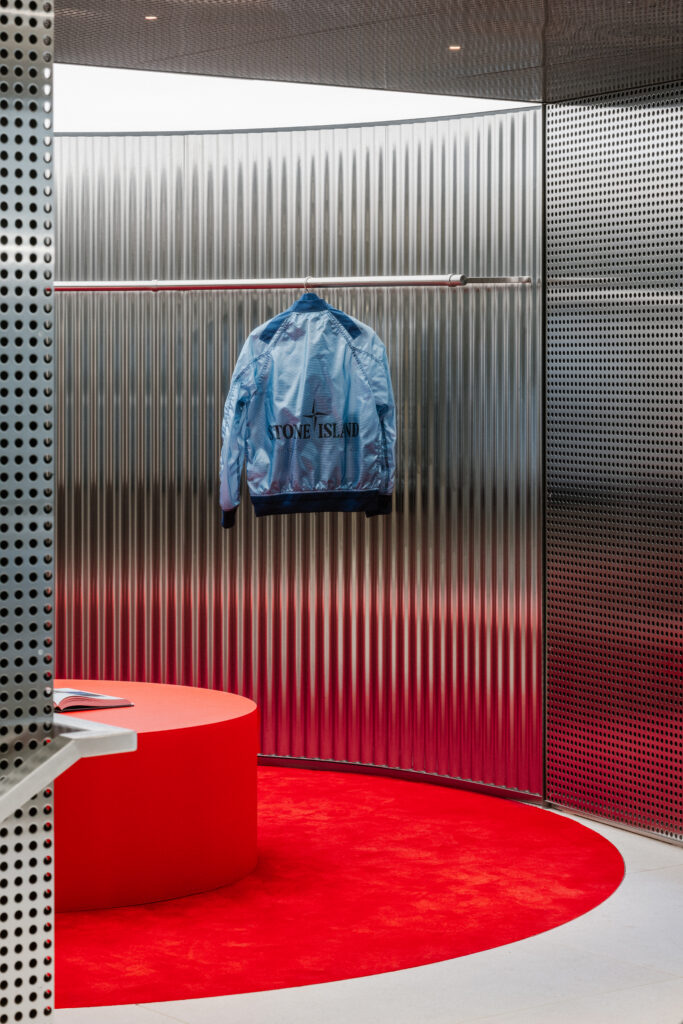
You have used techniques like sand-treating corrugated steel to soften its appearance. Why mirror Stone Island’s fabric treatments in the architecture?
If you do something you don’t have to do, it often gives greater satisfaction because you’re pushing your own limits. Stone Island doesn’t have to develop colours for each fabric from scratch, but doing so gives the work meaning.
I saw this as a form of discovery embedded in material research. Translating that into architecture creates a very specific language for the brand.
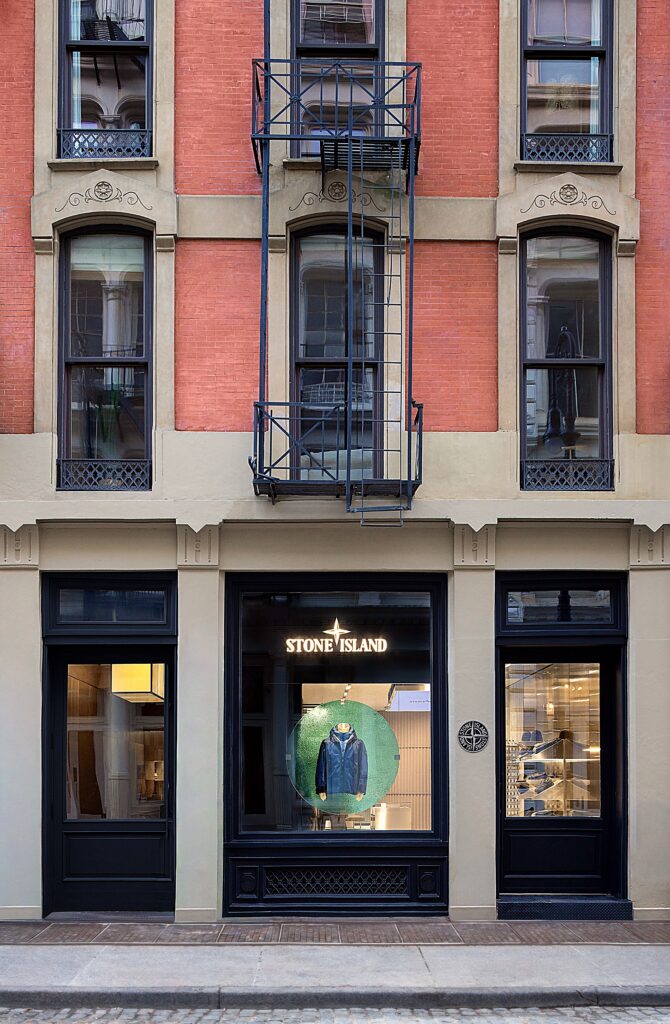
Stone Island New York Flagship by Bridget Beyer
Since AMO and Stone Island are built on experimentation, how did you manage the failures that come with research?
Glass was the most difficult [to work with]. It had to be the exact colour, texture and weight but also completely safe. We tested it repeatedly. Even in standard architecture, glass is challenging because it naturally has a green tint due to iron content in the base material. Controlling that was complex. It was frustrating at times, but also deeply satisfying when it worked.
Stone Island is built around a strong sense of community. How did you design the stores to facilitate that rather than simply creating retail spaces?
With retail architecture you must never underestimate the users. People immediately sense inauthenticity. The question was, how do you speak to collectors who have followed Stone Island since the 1980s while remaining approachable to someone discovering it for the first time?
Carlo Rivetti [president of Stone Island] once described Stone Island as a kind of religion. That sense of ritual is embedded in the brand. We developed “Altars”: glass vitrines displaying curated archive pieces from the ‘80s, ‘90s, early 2000s, and sometimes prototypes. For long-standing followers, it creates recognition. For new customers, it provides context. It’s not accidental. It reflects 40 years of experimentation and pushing limits.
Stone Island Paris by Benoit Florencon
You also collaborated with specific designers on elements within the space. How did those collaborations anchor the community feel?
The stores function as platforms for collaboration, much like Stone Island’s music events that spotlight new talent. I invited [lighting designer] Tim Hoojimans to develop the lighting because of his honest approach to materials. We also worked with [designer] Elvis Wesley to create an aluminium trunk on wheels for displaying collections like Ghost. These collaborations extend the language of research beyond architecture alone.
What is the common ground between the AMO and Stone Island teams?
They both begin with research. Research is almost a reflection of your discipline. From visiting the facility in Ravarino, I understood that Stone Island doesn’t conduct research because it has to. It does so to understand its community and to respond to changes in the world. That’s where we meet. As an architect, I don’t simply answer a brief. Understanding context and responding meaningfully comes from research. It creates consistency in your work.
Having worked across multiple cities, what has surprised you most about the Stone Island community?
I’ve met collectors from Korea, Germany, the United States, people who know the brand’s history intimately. They understand who shaped its legacy and how Stone Island approaches things differently. There’s a very strong message there and it’s not fabricated. It’s simply what the brand is and what it stands for.
by Francesca Colborne-Malpas