
NOW showing at Ikon Gallery in Birmingham, Upright is an exhibition of rarely seen works by Spanish artist Angela de la Cruz.
As soon as you walk into Upright at Ikon gallery, you are immediately confronted by four table legs being swallowed by a painting. The table barley standing is part of an exhibition of rarely seen works by acclaimed contemporary Spanish artist Angela de la Cruz and is a physical and playful exploration of the constraints of painting and the body.
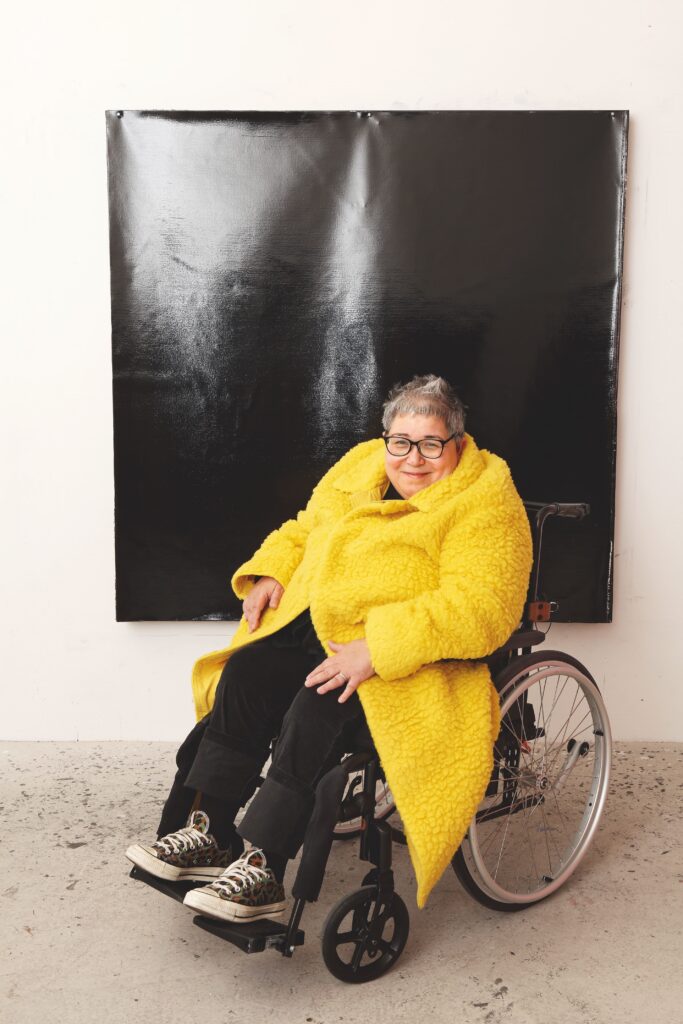
Angela de La Cruz. Photograph: Alexander James
The title was inspired by the world we live in: “I was thinking about finding ways to stand up higher to look at the world from above rather than below”, de la Cruz explains. Carolina Grau, guest curator of Upright, reflects on the humour, tension and physicality of the show, “Angela wanted to have the work in the visitor’s face, like these very aggressive four legs coming out to you.”
Angela de la Cruz’s works are sexy and shiny, yet also torn, battered, and playful. She approaches painting through a three-dimensional lens. She looks beyond the confines of the canvas, breaking, bending and mangling the frames. “I want to see what it’s like to push limits and how far such breakage can go. Testing limits as parameters interests me a lot,” she explains.
All of her works capture the physical dimensions of her body and play with the concept of a box as a container. Angela’s works are painted objects. They’re not sculptures, even if they have elements of sculpture within them,” Grau explains. Her painted objects are precarious and almost alive in their physicality. They have characteristics of their own.
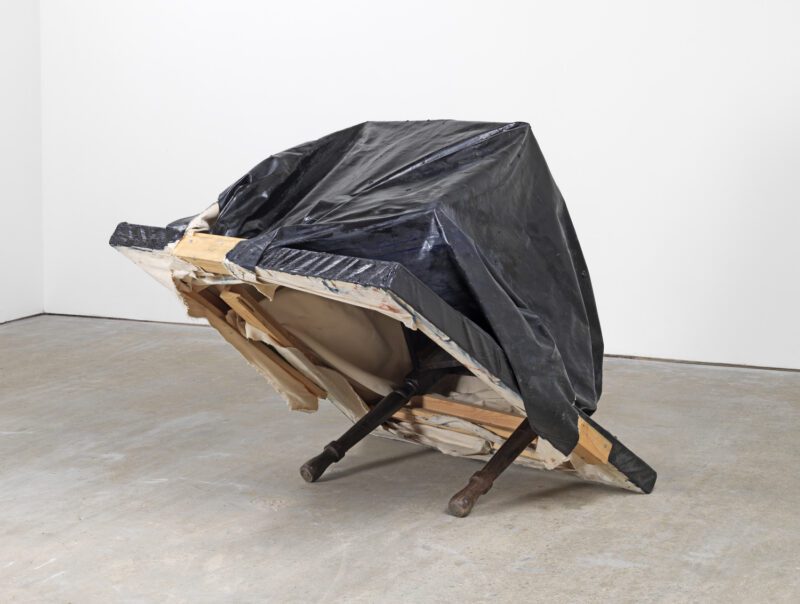
Angela de la Cruz. Still Life With Table(2000)Wood and oil on canvas, 90 x 105 x 100 cm© Angela de la Cruz. Courtesy Lisson Gallery. Photograph: Ken Adlard
In Reach (Red & Black) Two Parts (2002), one painting squashes another in an almost-toppling tower, inspired by the Catalonian Castell festival tradition, where people balance on top of one another in pyramids. The tension and personality of her works create characters of the found objects as they climb, swallow and balance, playing with each other and gravity.
De la Cruz uses broken domestic objects like chairs, pianos and wardrobes within her work. Propping up a broken chair with a stool in Three Legged Chair on Stool (2002) and two pianos in Upright Piano (1999), which is being activated for the first time for the exhibition. “My work has always been very linear, always, one form informs the next and so on. Sometimes elements from older works reappear and are reintroduced,” she explains, like her use of monochrome and chairs.
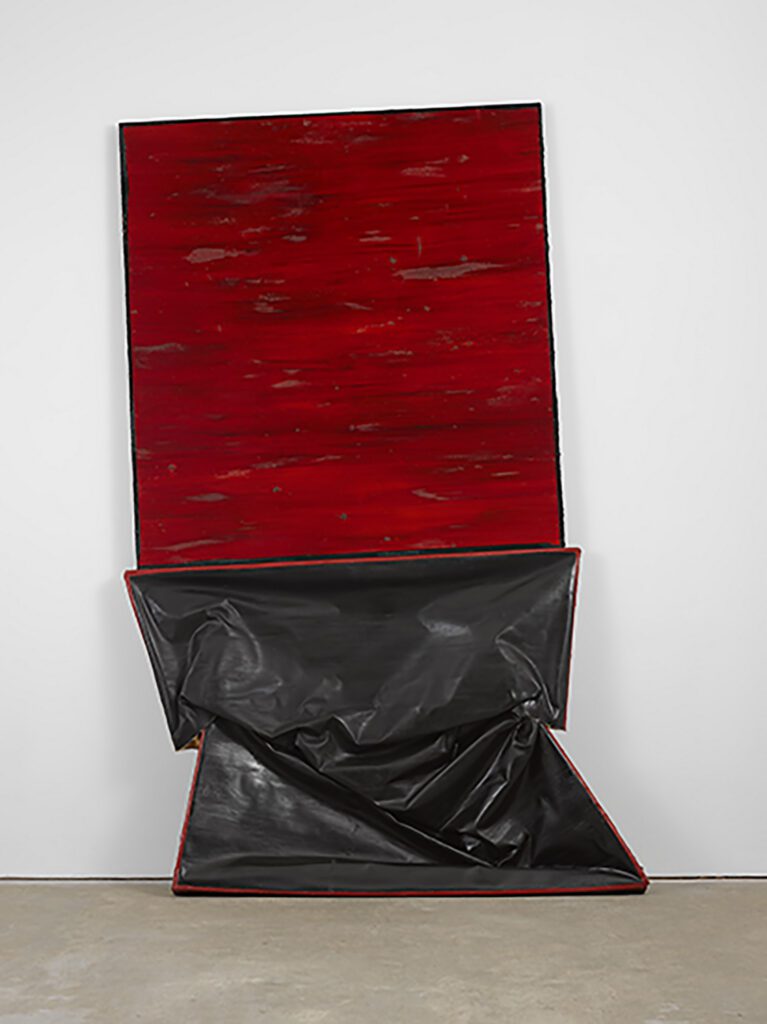
Angela de la Cruz. Reach (Red/Black)(2002)Oil on canvas, 317 x 182 x 40 cm © Angela de la Cruz. Courtesy Lisson Gallery
Curating such imposing works, with such distinct characters, is a challenge Grau has faced before, having curated a mid- career retrospective of Angela de la Cruz’s work in Bilbao in 2018, “you cannot put a lot of Angela’s works in a space because, no matter the size, they are very physical,” says Grau. This exhibition differs as many of the works haven’t been seen in the UK before and includes a new commissioned work, The Nutcracker, inspired by the time de la Cruz spent with the Birmingham Royal Ballet.
“We didn’t want to mimic a show from London. We wanted to do something different,” Grau explains. De la Cruz and Grau first met in late 1996 and have worked together throughout that time. Grau has developed an in-depth understanding and respect for de la Cruz and her work, which explores the shifting conditions of life, the cycles of collapse and rebuilding, and resilience both physically and emotionally.
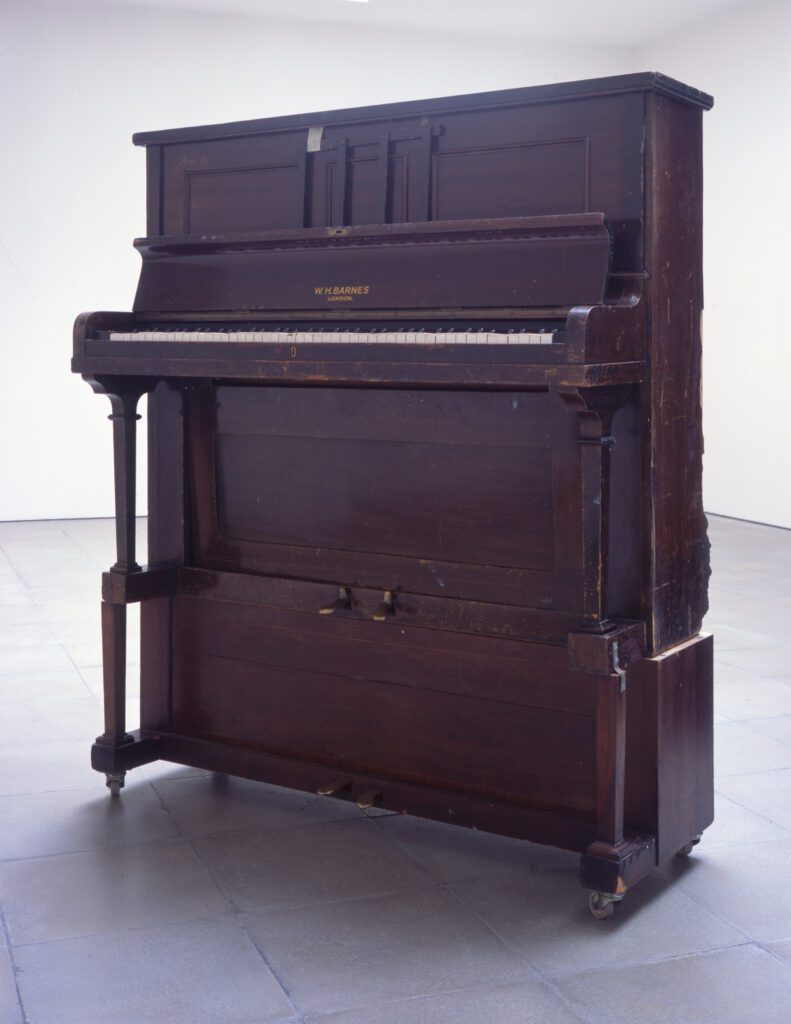
Angela de la Cruz. Upright (Piano)(1999)Mixed media and upright piano, 170 x 60 x 14 cm © Angela de la Cruz. Courtesy Lisson Gallery
Exhibiting in Birmingham for the first time was important for de la Cruz to widen her audience; “It’s also important for me that not only local people in London can see my work in person”, she explains. “It also made me aware of the severe funding cuts for institutions in the UK; it really is a shame,” she continues.
Having suffered a stroke in 2005, remaining in hospital for two years, and not creating art for three, she knows something of resilience and courage, saying in an interview for the Sunday Times, “I didn’t ever doubt that I would make art again one day. Artists can be away from their work for ages and still come back to it. And if I can do it, anyone can.”
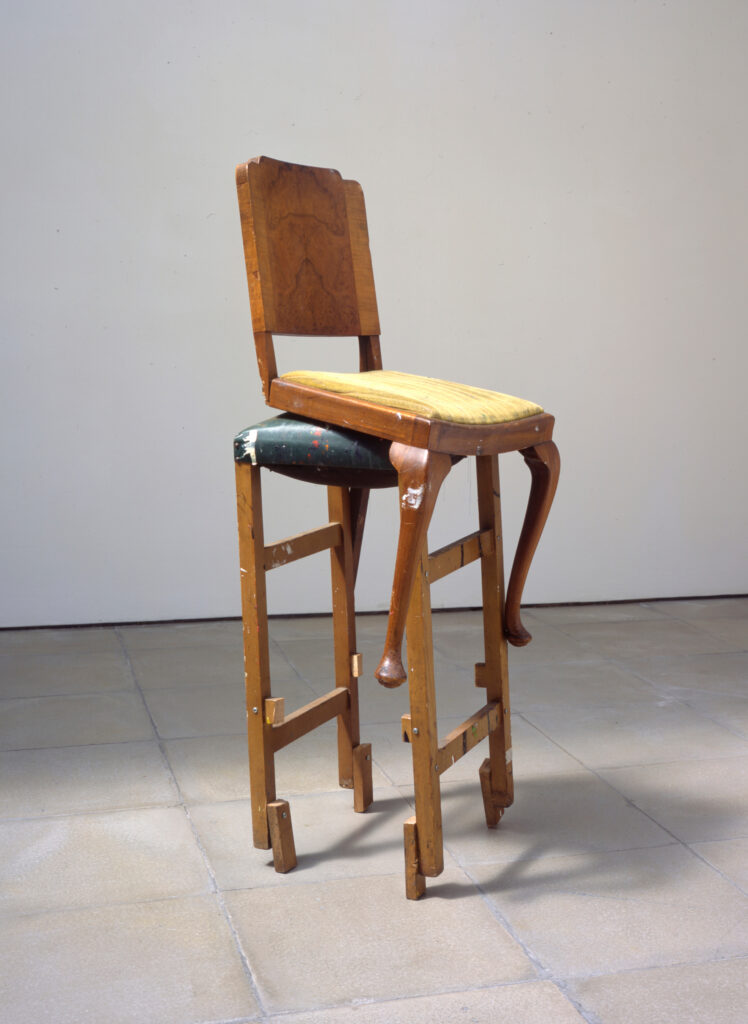
Angela de la Cruz. Three Legged Chair on Stool (2002)Wooden chair and wooden stool, 125.5 x 50 x 45 cm © Angela de la Cruz. Courtesy Lisson Gallery
Much like herself, her artworks have experienced life and have the wounds to show for it. They are resilient, picking themselves up after collapse and struggle, powering through. When I asked her about what gave her the courage to make art again, she humbly explained.
“I was born with a very positive attitude, luckily, which has allowed me to move forward. I think fundamentally I have not changed; now I just need to plan everything more carefully. I don’t have time to contemplate and meditate on my work for long periods of time like I used to; I have to view it more from the sidelines now, but it has not affected the quality of my work.”
by Sadie Pitcher
Upright is open from now until September at Ikon Gallery, Birmingham.