
ON THE 180 year old Hollywood Road, where antique shops jostle with crystal shops, a very specific kind of drama is playing out. Inside Liang Yi Museum , this exhibition is not just a jewellery show. It is a beautifully lit showdown between two houses that once dressed royalty, socialites and serial cruisers in enamel and excess.
Before the eggs and the enamel, there are three people in the room. Gilles Zalulyan is a third‑generation jewellery dealer and the founder of Palais Royal, a gallery with salons in Paris, Hong Kong and Amsterdam.
Zalulyanhas worked as a jewellery dealer for over 25 years. that has built its reputation on historic Cartier and Fabergé. Connie Luk is a Hong Kong‑based jewellery specialist who has worked at Christie’s and now holds a senior role with Palais Royal’s Hong Kong operation, moving between connoisseurship, client work and exhibition projects. Janine Hua is Curatorial Coordinator at Liang Yi Museum, the private Hong Kong institution known for its collections of Chinese furniture, European silver and bejewelled vanities. Together, they have helped bring the exhibition Fabergé and Cartier: Rivals, Visionaries, Mastersmiths brought to life.
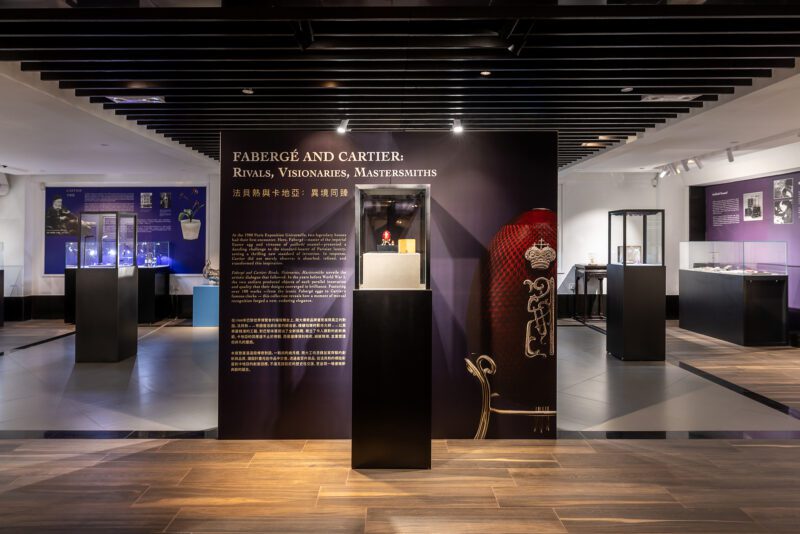
Entrance to the Exhibition
Seen together, Fabergé and Cartier shift from being simply two grand names to representing two ways of looking at the world. Fabergé seems obsessed with intimacy and craft so intense it borders on the obsessive, “always working millimetres from the skin,” as one of the team likes to say when they describe how these objects sit in the hand.
Whereas, Cartier focuses on composition, building a complete fantasy you can wear to dinner or a ball, “a whole scene that arrives finished, like a still from a film,” as Luk frames it for visitors. Most visitors know Cartier mainly from red boxes and perfume ads.
Placing them side by side in Hong Kong changes the frame again. The rivalry stops being only Paris versus St Petersburg, or czarinas versus maharanis. It becomes a lens on a city that has long traded on speculation and desire; here that city is hosting a very intimate argument about taste, value and who gets to decide what a masterpiece looks like.
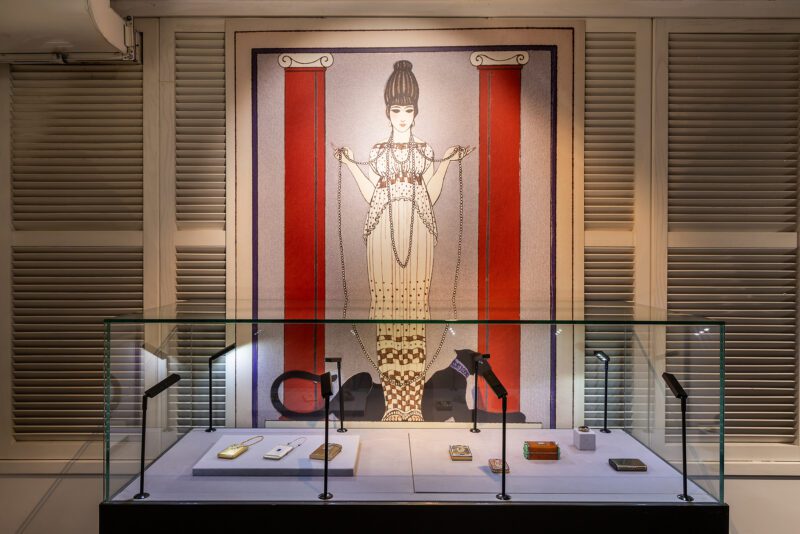
Art Deco Vanities
The story starts small, with two men talking shop. Working together since 2012, Zalulyan has supplied collector‑turned‑museum‑founder Peter Fung with vanity cases and outrageously unique little objects. For more than a decade, transactions turned into conversations about art, technique and the strange survival of these tiny, extravagant things in a city built on utility and speed.
When the idea of a joint exhibition finally surfaced it did not arrive as a formal pitch, it felt more like a continuation of a running conversation. “We have been talking about this for years, shall we just do it now,” Zalulyan recalls. They emerged with a shared decision: Fabergé and Cartier would finally share a space.
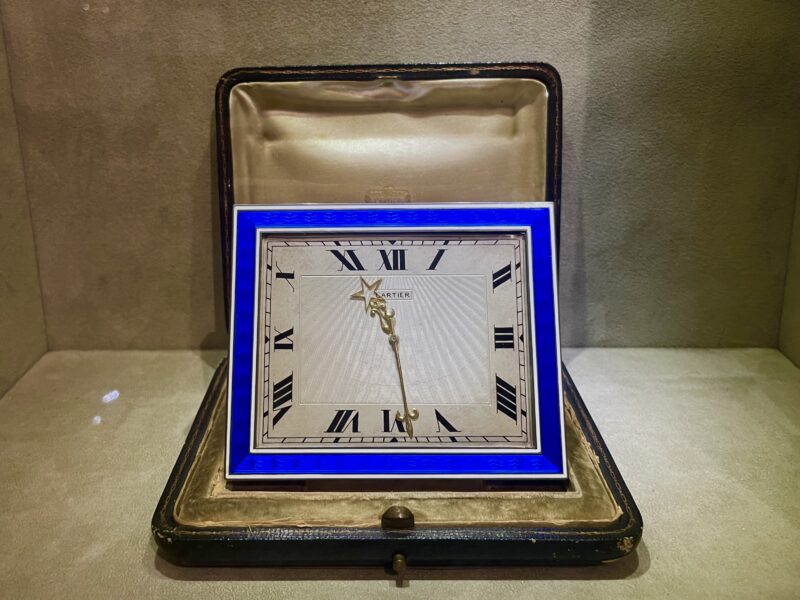
Desk Clock, Cartier, c. 1920, Silver-gilt and enamel, Height 9 cm | Palais Royal Hong Kong Ltd Collection
At the centre of the show sits the kind of object dealers fantasise about and scholars approach with caution. It is a newly identified Imperial Fabergé egg that was presented in 1905, on the bright holiday of Easter, Nicholas II presented his long-awaited son, the heir, with his first Easter gift. The egg is made from the highest standard silver, which is 91 in the zolotnik system.
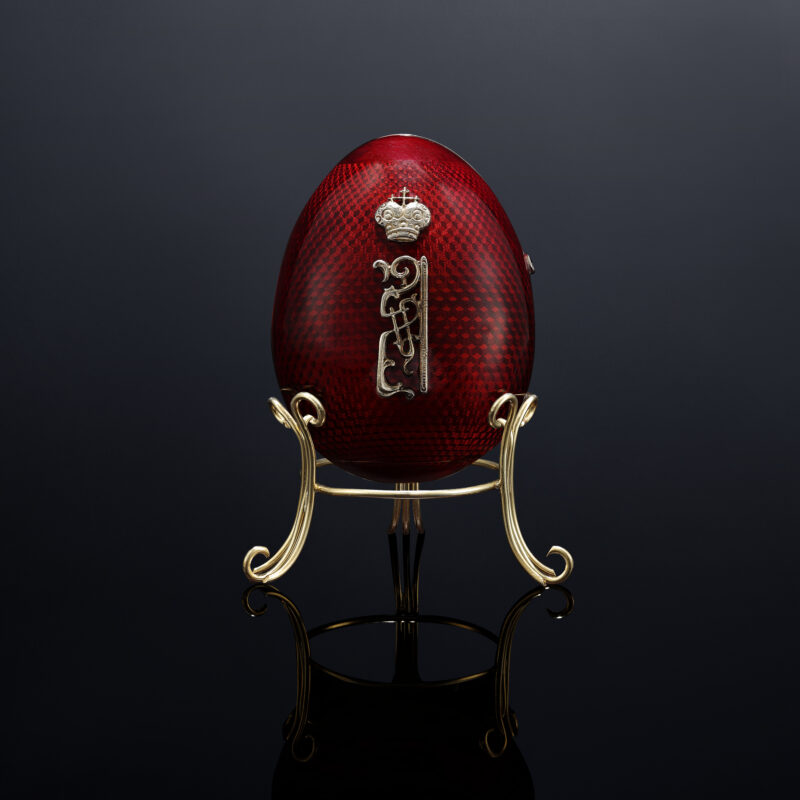
The “Tsesarevich” Egg of 1905 | Carl Fabergé, 1905, Gold, silver-gilt, enamel, sapphire and diamond, Height 6.3 cm Private Collection | Courtesy of Palais Royal Hong Kong Ltd, Exhibited: Fabulous Carl Fabergé, Geneva, 2-6th November 2022. Organised by Igor Carl Fabergé Foundation Published: Fabulous Carl Fabergé, 2022, no. 119 *The stand was later added
Upon closer inspection, the monogram of the tsar’s son lands like a shock; Zalulyan is blunt about it and notes that you cannot simply put the monogram of someone so important on a piece “just because you want to.” “So there is no discussion about it,” he states. “It’s a monogram of the son of the tsar. So the only discussion is why people have missed it?”
The egg was made in the workshops of the Imperial Stroganov School, as evidenced by the I.S.U. maker’s mark, as well as a silk lining with the logo of the School. So the real question is not whether the egg is authentic, but how history managed to miss what was in front of them? In this exhibition however, a century-long mistake is being quietly corrected.
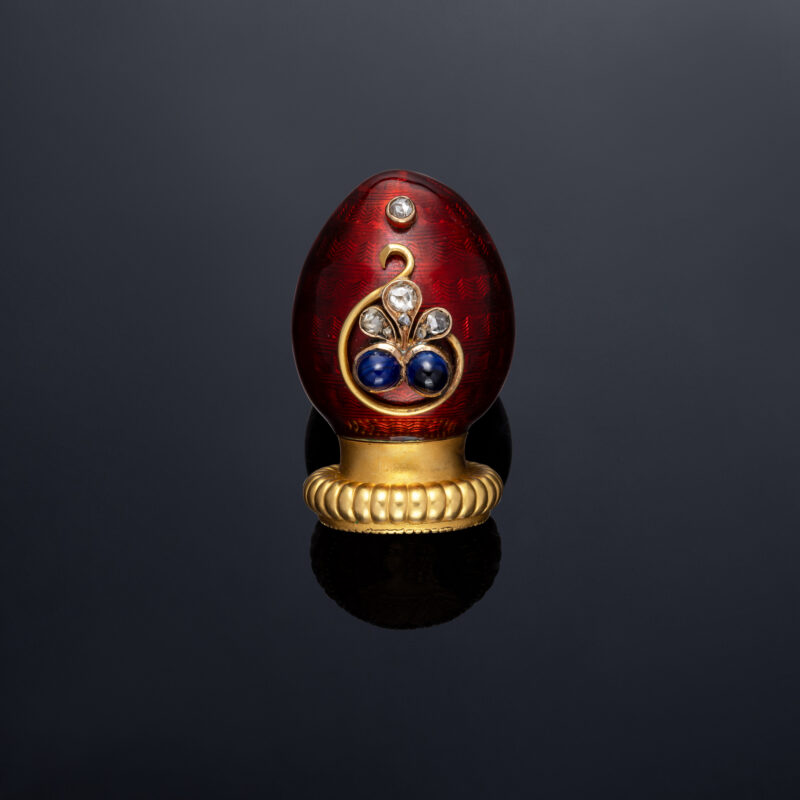
The Surprise of The ‘Tsesarevich’ Egg of 1905, in the Form of a Seal, 1905
The tension becomes clear. For a dealer, a piece like this feels like a holy grail story. It is a miscatalogued masterpiece that proves your eye is sharper than the cataloguer’s, “the kind of thing you dream of finding once in a lifetime,” Zalulyan says.
Yet every story has a darker twin, an attribution that collapses under scrutiny. Placing the egg in a museum turns it into a kind of high‑wire act. Visitors are invited to look, to weigh in on the claims, to form their own opinions, to “decide for themselves whether the story holds,” as Hua puts it when she talks about how the label is written. Velvet, vitrines and spotlights frame an object that is both prize and provocation.
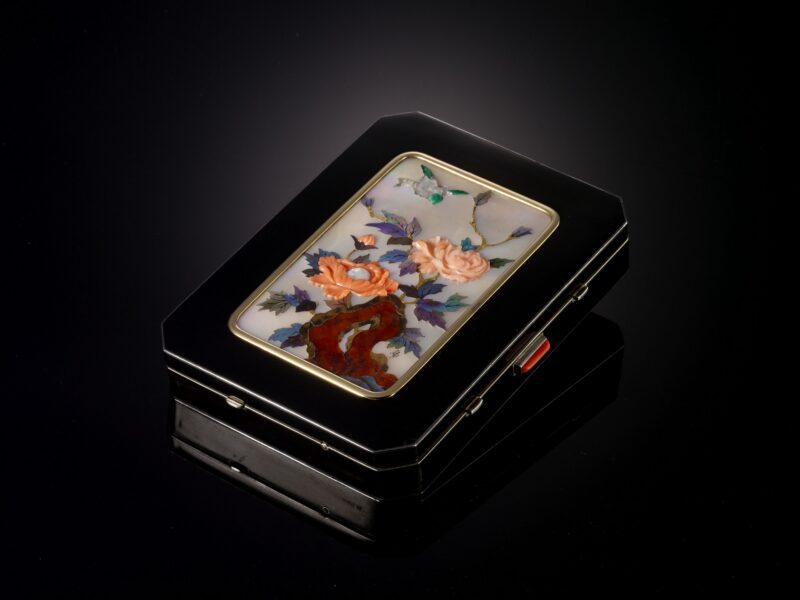
Nécessaire With a Comb, Signed: Plaque Makowsky, c. 1925, Silver, enamel, fine stone, tortoiseshell and coral, Length 9.2 x Width 6.9 x Height 1.5 cm, Liang Yi Collection

Study of an Orchid, 1907, Cartier, Aventurine, agate, enamel, sapphire, gold, bronze and glass, Height 26.8 cm | Palais Royal Hong Kong Ltd Collection
Around this charged centre, the exhibition leans into theatre at the scale of a jewel. Hua explains why; “Fabergé plays with close to a hundred colours, while Cartier prefers a tighter vocabulary” Zalulyan adds another layer of detail and notes that the technique “creates this kind of opalescence because they put many layers of enamel.” Light does not simply bounce back to the viewer. It appears to sink into the object and then return slowly. “The more you put layers, the more you create an opalescence,” he says, and then adds the punchline: “More is magical, more is beautiful and more is complicated.”
Meanwhile, Luk has to turn all this connoisseurship into something a Wednesday visitor can actually feel. In Hong Kong, Fabergé is not a household name; many people remember only that they once saw an egg exhibition in Sha Tin. So she starts with odd little objects that make people pause.
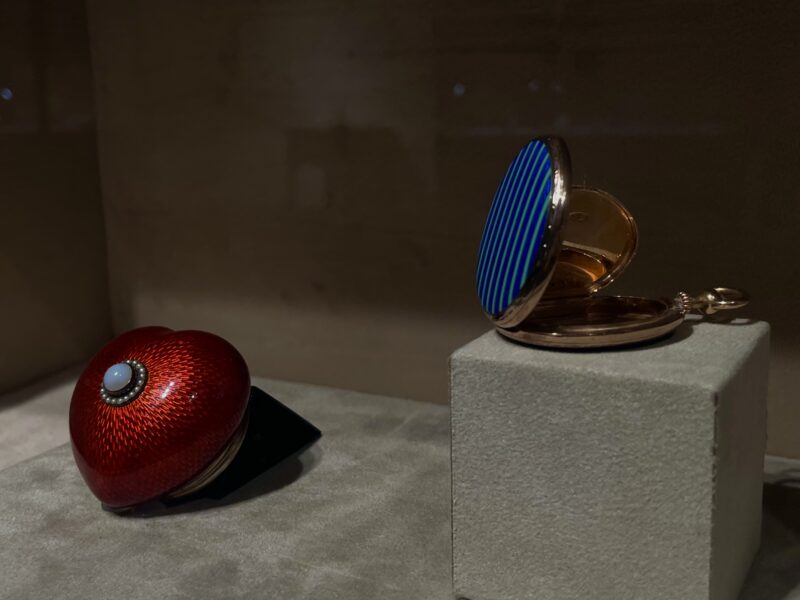
Palais Royal Hong Kong Ltd Collection Bell Push, Workshop of Mikhail Perkhin, Carl Fabergé, c. 1900 | Silver-gilt, gold, enamel, chalcedony, pearl, Width 5 cm, Provenance: Grand Duchess Elena, Vladimirovna and Prince Nicholas of Greece, Palais Royal Hong Kong Ltd Collection | Powder Compact, Workshop of Feodor Afanasiev, Carl Fabergé, Inventory Number 20298, 1911, Silver, gold and enamel, Diameter 3.1 x Width 3 cm, Palais Royal Hong Kong Ltd Collection
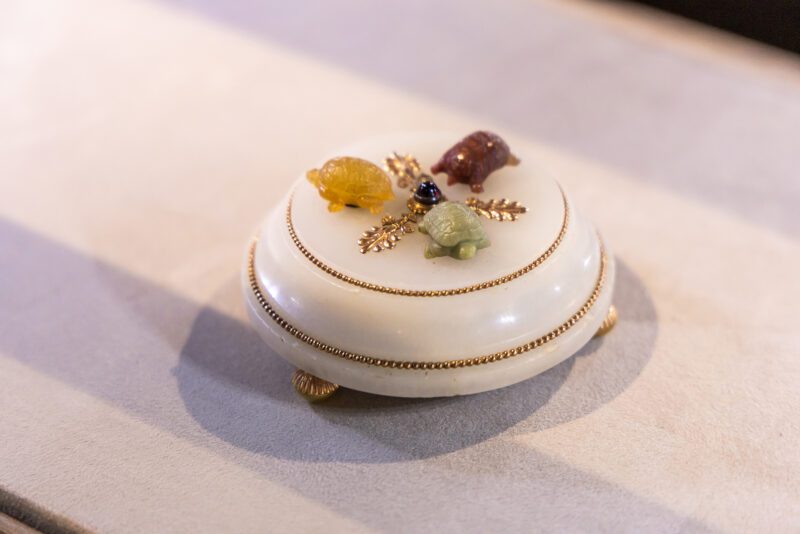
Three Turtles” Bell Push, Carl Fabergé, Inventory Number 5513, 1901, Agate, bowenite, garnet and gold, Diameter 8.4 x Height 4 cm, Provenance: Empress Maria Feodorovna, Palais Royal Hong Kong Ltd
One favourite is a small Fabergé bell push owned by Maria Feodorovna. On the label it is described as an electrical switch; in the case it reads as a tiny sculpture with three carved stone turtles, each wired to a different room. Luk recalls her first encounter with it and her own question: “What on earth is a bell push?”
From there, the story unfolds. Electricity arrives in the imperial home and Fabergé responds by turning a doorbell into a jewel. A practical new technology becomes an invitation to perform modernity on a desktop. Suddenly this is no longer just a button. It is a story about how the ultra‑rich experience changed first and insist it looks good while doing so.
Perhaps that is the real pleasure of this exhibition. There are Imperial eggs and guilloché surfaces that make you want to lean in too close to the glass. There is also a refreshing honesty about the truth behind the shine. A dealer admits to risk and obsession. A curator talks happily about enamel thickness.
The exhibition does not try to clean up the collision between scholarship, ego, money and love of objects. Instead, it invites you straight into the tangle. Then it hands you an opalescent egg and a jewel‑crusted turtle and gently throws the question back. What do you think this is worth, and why?
by Ellis Dowle