
WHAT does ‘Super Nature’ mean? This season, for Nicolas Ghesquière, it meant reconciling his designs with the natural world and engineering them for the modern wearer.
Enter Louis Vuitton’s Autumn/ Winter 2026 womenswear collection. Taking place on the conclusive day of Paris Fashion Week, the show was staged within an abstract ‘neo-landscape’ replete with verdant moss. Here, clothes effortlessly tapped into the synergy between clothes and the environment, and animalier patterns placed alongside ‘flora and fauna’ left conspicuous ‘imprints on garments’.


Picture an island of fashion press and influencers, all contained inside a trompe l’œil blue moat, gazing upon a geometric, grassy and green-hued mountainscape. Dreamt up by Jeremy Hindle, the production designer behind the hit sci-fi series Severance, the unexpectedly picturesque environment immediately offered a fitting prelude to Nicholas Ghesquière’s vision: one perceived through a futuristic lens yet unabashedly grounded in nature.


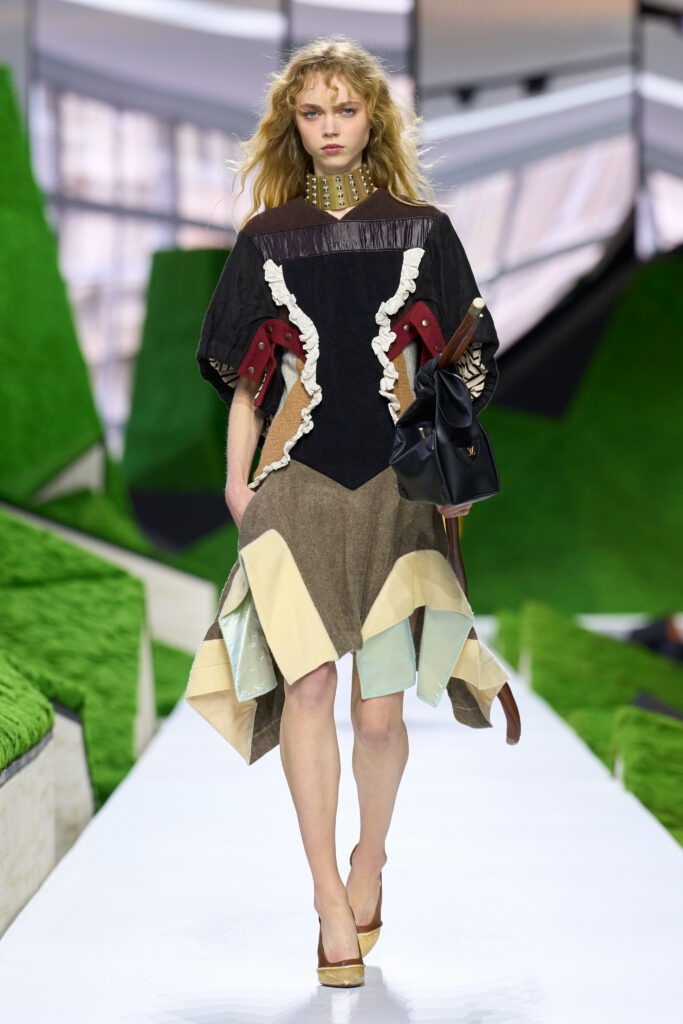
Traversing the scene were silhouettes far removed from the more restrained shapes of last season – think outrageously broad shoulders, thick textural leathers, woven canvases and vegetal faux furs woven into outerwear, floaty skirts, and Kepeneks – tent-like Turkish garments traditionally worn by shepherds.
With the latter sleeveless structure emerging from the designer’s efforts to authentically reflect the lives of those inhabiting real-life mountainous and woodland communities, this collection was a love letter to those harmoniously coexisting with the earth’s natural resources.


Mirroring this approach further were monogrammed handbags suspended from staffs (reminiscent of Dick Whittington-esque bindles), quaint cottage-shaped handbags, heels tapered to resemble antlers and pleated midi dresses crafted with high collars and earthy tones. Fabrication, too, alluded to Ghesquière’s anthropological stance, with fur clinging to cosy capes, cocoon coats and shaggy jacket trims, all topped off by comically wide sailor hats bearing tufts of soft shearling.
The concept of ‘Melding technologies with the timeless ingenuity of human artisanship’ was brought to life through subtle floral embellishments, snippets of satin, supple leathers dyed to resemble rich brown wood, and flourishes in the form of buttons made to resemble minerals.
Converging childlike wonder with wearability came lamb illustrations by Ukrainian artist Nazar Strelyaev-Nazarko, which injected a sense of whimsy onto printed plaid skirts. This tied in with the collection’s overarching theme of ‘A new folklore, for the future’, where people and planet find themselves on the same page.


With Ghesquière’s sartorial ‘prism of tomorrow’ transporting us beyond the Louvre’s Cour Carrée courtyard, this collection proved that when nature is put into conversation with clothes cleverly, the result can be truly ‘super’.
by Ella O’Gorman